The Invisible Hurts We Carry

cryingwoman

Sometimes tears don’t surprise me. Perhaps I’ve been feeling sad for a while, or I can feel a need to cry behind my eyes. At other times they do catch me by surprise. Often when I’m doing listening time I’ll be talking and then suddenly I’ll start crying about something I didn’t even know I was sad about. Something I wouldn’t even have thought would register as a hurt.

This happened yesterday when I was talking to my listening partner about getting in contact with two possible schools for my daughter to attend in August. When we visited one school they didn’t make much effort at connecting with me, or making me or my daughter feel welcome. Another school were much more welcoming, and made small gestures that showed natural human kindness. I felt much safer about sending my daughter there, because they were warm, and friendly.

As I told my listening partner how grateful I was about the small ways that school had made us feel welcome I started crying. Later I realised how terrifying the possibility had been to send my daughter somewhere where I wasn’t sure her emotional needs were taken care of. I was so grateful to have found another possibility that I cried with relief.

There are literally hundreds and thousands of little hurts like this that we carry inside our minds. They raise our stress levels, and effect our health, both emotionally and physically. They get in the way of our thinking, and our ability to be calm, loving parents. We may not be even consciously aware of these hurts.

When we begin listening time, we may just start talking about small minor everyday niggles, but as we follow our train of thought with a partner we trust, we will naturally be led to our tears.

Often when we have a present hurt there’s a thread of hurts that can be traced all the way back to early childhood. For instance, as I work through feelings about my daughter starting school I know it’s not just her separation anxiety that I have to contend with. It’s also my own past experiences with being bullied at school that are making me feel nervous and anxious about our choices.

My daughter’s limbic system (the emotional part of the brain) will be picking up on my anxious feelings, and her transition to school won’t go smoothly unless I can heal my own past.

Despite our nervous feelings, I think we are both looking forward to this new adventure. We can walk this healing path together.

For more info check out How Telling Your Life Story Transforms Your Parenting. And if you’d like to try listening partnerships with me, I have an online Parenting by Connection starter class beginning next weds May, 18, 8:00pm central european time, (7pm UK time, 11am pacific time)

cryingisokayhere

Photo Credit Miss O’Crazy 

How Telling Your Life Story Can Transform Your Parenting

KATE_ORSON_WEBThis post was previously published on the Juno Magazine website

When Patty Wipfler was a young mother, she met a younger acquaintance who asked her what being a parent was like. Patty burst into tears. She explained that although she had always loved children, parenting was so much more exhausting and stressful than she thought it would be. She confessed that she was starting to lose her temper, being aggressive towards her children in a similar way to how she had been treated as a child. As Patty talked and cried, the woman just listened.

Afterwards Patty went home and found that she felt completely different. She had much more energy, and renewed patience to be with her children again. When she next met the young woman she asked her what she had done. The woman explained to Patty the simple method of listening she had used, and how it can help us to release our feelings.

Patty began taking classes in listening, and exchanging listening time with another parent. She explored how simply talking about her feelings, laughing, crying, and reflecting on her own childhood helped her to get rid of the emotional obstacles that were standing in the way of her being the parent she wanted to be. She now shares everything she has learnt through her organisation Hand in Hand Parenting.

Telling your own life story is fundamental to bringing up happy, emotionally resilient children. What Patty discovered intuitively is now supported by the latest research. A study conducted by the University of California, Berkeley showed that it’s not what happens in our childhood that determines how we parent, but how coherent our story of our childhood is, and how we make sense of it.

The researchers defined a coherent story as one that went beyond simple labels like ‘happy’ or ‘terrible’ and went into more detail. Coherent stories combined events and emotions in a way that made sense, rather than being simply a description of events without the person’s emotional reactions or responses, and without clearly explaining what caused those emotions. The study concluded that telling a coherent story is the single most important factor that determines how well our children are attached to us. The researchers also found that there is a relationship between the parts of our stories that we struggle to talk about coherently and the parts of our adult life where we have difficulties.

When it comes to parenting, history often repeats itself, even when we don’t intend it to. We can have the best of intentions to be peaceful parents, but we can find ourselves losing control and reacting in ways that we are not proud of, particularly when our children do things that push our buttons. This almost always happens when we are feeling stressed and exhausted ourselves.

In Parenting from the Inside Out, Dan Siegel explains what happens in the brain when we become stressed. The limbic system – the emotion centre of the brain– gets flooded with emotion, while the prefrontal cortex – the rational, thinking part of the brain that governs impulse control – becomes deactivated. When our child does something that pushes our buttons, such as dropping food on the floor on purpose, or hitting a sibling, it can trigger unconscious memories of our own childhood and how we were treated in a similar situation. These memories activate our own strong emotions, so it’s hard to think clearly in the moment. We may respond in an automatic way rather than thinking through our response. We may simply repeat what our parents did to us when we were children.

Telling our stories helps us to diffuse some of the potency of the past. We can fully process and release our emotions about our own experiences, so that we are no longer reliving them in the present. Then when we find ourselves in a stressful situation with our children, we can bring ourselves back to emotional equilibrium and think clearly about how to respond.

Crying is an essential part of this process of storytelling. We all know the feeling of having a good cry, especially with someone we love and feel safe with. Shakespeare wrote, “To weep is to make less the depth of grief,” and now science supports what writers and thinkers have thought for years: crying makes us feel happier and healthier and is part of our natural, inbuilt recovery mechanism from stress and upsets.

Another research study showed that people in therapy were found to recover better and make more positive changes in their lives when they cried during their sessions. Through crying (and laughter too) we can release the emotional charge from our experiences, so that we can make sense of what happened and tell our stories more coherently.

When we have a supportive listener and the safety and space to tell our stories, we will be led to our tears. It might not happen instantly, as we have all to some extent developed patterns of trying to hold in our feelings. But over time we can recover our natural healing ability. We may cry about memories long buried in the past, events we didn’t even know we were upset about. Our true feelings emerge about things we may have put on a brave face about, or felt numb about. The writer Louise DeSalvo describes the recovery of feelings like these as “the things we would have felt at the time if we weren’t so afraid”.

To begin to discover the benefits of telling your story, find a friend, or begin a listening partnership through the Hand in Hand Parenting community, either online or in your local area. Ask each other this simple question: “How’s parenting going?” Spend five minutes talking, and then five minutes listening to your friend or partner. Follow some basic guidelines not to interrupt, give advice or tell your own stories while the other person is talking. Make an agreement to keep everything you say confidential and not refer to it outside the session.

You might not burst into tears like Patty did, but you will start to create the space and safety to listen to your own feelings. You can discover how your present actions relate to the past.

You can also write down your thoughts or memories. Ideally it’s best, though, to have a listening partner. That way when you feel emotional you have someone right there to laugh and cry with. Because we have a history of hiding away our emotions, of being sent to our rooms or told not to cry, it is a powerful antidote to have someone there who really accepts us unconditionally, whatever we’re going through.

Another way of using a listening partnership is to think of the areas of your life where you’re currently struggling. It could be to do with parenting, or it could be other aspects of your life that you’d like to change. Or it could be the things that trigger you about your child, that make you lose it or feel stressed and overwhelmed. Make a note of these as potential topics to talk about. You can ask yourself (or a listening partner can ask you) whether this situation reminds you of anything in the past, or of how you were treated as a child. If we trace our present issues back to the past and release the emotion we’ve been carrying, we can think more clearly about how to deal with the present.

WhKATE_ORSON_WEB2en my daughter turned two I began noticing that she was shy around new people. This is a common response for a toddler, but it made me worried. When I was a child I was badly bullied, and I went through a time where I struggled to make good friends. I would talk about this in my listening time, simply describing whatever memories came into my mind. As I talked to my listening partner, the emotion of what happened welled up in me, and I started crying. My listening partner provided safety so that I could release feelings I’d been carrying around with me ever since the bullying.

Every time I talked about what had happened, I shed a few more of those old feelings. I noticed that after a listening partnership little pieces of my confidence came back. I became less and less shy, and more comfortable with myself. I also worry less now about my daughter’s shyness. Without my own upset feelings in the way, I could think more clearly about how to help her.

Shortly after I’d done a lot of sharing in this way about being bullied, my daughter and I were at the house of a new friend I’d recently met. Her 2-year-old son was running in and out of the room. My daughter sat on my lap sucking her fingers, a sure sign she was feeling nervous. I played a game where I pretended to be scared of the boy too. Every time he ran past, I’d jump back with my daughter, saying, “Ooooh!” Soon she was laughing. This is one of the Parenting by Connection listening tools for children that help us to help them process their emotions.

Playlistening means picking up on something that makes our child laugh, while we take on the less powerful role. We repeat it over and over to get the giggles going. When I pretended to be scared, my daughter got to feel powerful, and the laughter helped her to release some of her nervous tension. After a few more minutes of playing this game, my daughter was happy to go and play trains with her new friend, and they got on really well for the rest of the afternoon.

That day I was feeling relaxed and confident. I was able to leave my own past behind and focus on what my daughter needed in the present. If I hadn’t done the work on myself, I’d have just been sitting there feeling as nervous as she was, and I wouldn’t have been able to help her. My daughter would probably have picked up on my feelings and felt even more uncomfortable. Now I had released my feelings I could help her grow in confidence too.

Our children are our greatest teachers. They will find the places where we need to figure out more about ourselves and our past. Parenting is a chance to grow and sparkle, to be our best selves. Through the challenges we deal with, the laughter and tears along the way, we become the parents our children need us to be. Having a rich understanding of our own emotional lives lays the foundation for having the empathy and patience to cope with our children’s strong emotions.

Things to Try

  1. Tell your life story. The best way to do this is with a listener. Divide the time and take turns to talk and listen. Jump from memory to memory, following your stream of consciousness.
  1. Focus on parenting:
    1. Write down three things you liked about the way you were parented.
    2. Write down three things that you would do differently.
  1. What triggers you as a parent? What behaviour in your children evokes a strong reaction in you? Let your feelings of irritation out with a supportive listener.

For more information about listening partnerships check out Hand in Hand parenting’s online self-study course Building A Listening Partnership.

The Pramshed

Giggle Parenting For No Reason

shutterstock_343677584

A lot of my giggle parenting posts have focused on using laughter to deal with specific family challenges. Although this is a great way to apply the giggles, it’s also worth bearing in mind that of course we can laugh and have fun with our children for completely ‘no reason.’

Today I went down to the cellar with my daughter to hang up some wet washing. There were some dry towels and other clothes hanging up. As I hung up the wet stuff, I told my daughter in a playfully serious voice, ”okay, I really don’t want you to pull down that towel.”

She immediately yanked down the towel, then went to pull down a pair of trousers. I chased her around putting things back up, and acting playfully exasperated. It became a race for her to pull things down, and for me to put them back up. We had lots of fun and laughter. (by the way, the cellar floor is immaculate so I wasn’t worried about the clean washing getting dirty! And there were only a few things she was able to reach, most were too high up)

Now you might be thinking, why on earth would I encourage my child to pull down clean washing and dump it on the floor? What sort of parenting lesson does that send?

Well time and time again I’ve seen that if we let our children be ‘naughty’ in a controlled way, it massively reduces the chance that they will misbehave in real ways. We had both been ill this week and had been missing out on playfulness, so I spotted my chance to leap in and have a few giggles. I know that every time I invest time in connection, I’m increasing the chance my daughter will be co-operative when I really need her to be.

So if you have a few moments to spare, and get some inspiration for what might make your child laugh (while they are in the more powerful role) then try out some giggle parenting.

You might also like

Why You Should Let Your Children Be ‘Naughty’

What To Do When Your Child ‘Just’ Wants Your Attention

Giggle Parenting – The Best Discipline Tool Out There 

Why Tantrums Are Not A ‘Behavioural Issue’

tantrumming

This week my daughter and I have been home suffering with a bad cold, so I haven’t felt like writing much. In the meantime I’ve been really enjoying getting into the world of blogging, and reading blogs from other parents and joining in link-ups that I’ve been discovering via twitter.

On the #BloggersClubUK link-up I came across this post Made To Feel Like A Failing Mother which really shocked me.

A mother took her son to a local singing group at a children’s centre. He ended up having a massive tantrum, and she left. Later on she was called up by a staff member from the children centre recommending they talk to another woman who worked there to discuss her son’s ‘behavioural issues.’

This is just wrong on so many levels. Tantrums are a completely natural, normal part of healthy child development. Tantrums are not a form of ‘bad behaviour,’ they’re a way of expressing emotion. When they happen in public it can be extremely embarrassing, and we all do our best to deal with them while worrying about what people will think of us!

This mum absolutely did the right thing, she took her son out of the singing class, and stayed with him till he was in a better mood.

Sometimes toddlers can tantrum for a long time, and all we can do is ride out the storm until they pass. This is actually the best thing we can do. To let our children get through their moment of upset, and out the other side. They’ll be in a better mood because we’ve given them the space to have their feelings.

In my post here, I share how listening to children’s crying, and tantrums is actually key to keeping their behaviour on-track.

Sadly, there isn’t a great deal of understanding about the importance of allowing children to express their feelings. Sadly there are people out there who will look at a tantrumming child and think that the parent is doing something ‘wrong.’ Sadly a lot of parenting advice focuses on stopping tantrums, and inadvertently teaching children that expressing emotions is wrong.  I’d steer clear of any parenting advice that focuses on tantrums being a ‘behavioural issue.’

Next time you see a parent dealing with a tantrumming toddler, just remember this, that they are a good parent, doing their best. Instead of rushing in with judgmental looks or ‘advice,’ give them an understanding smile, some warmth, and support. We all have hard days, and we don’t need to make parenting any harder for each other!

You might also like, Why This Isn’t Another Article About How To Stop Tantrums, and What To Do When Children Have Tantrums In Public

Brilliant blog posts on HonestMum.com

Giggle Parenting For Thumb Sucking

thumb-sucking_1656557c-300x187

Thumb sucking or using a dummy (pacifier) is a common aspect of child behaviour, and it can seem completely natural for a child to stick their thumb in their mouth, or use a dummy for a substitute. However thumb sucking is usually a sign that your child has some stored feelings that they haven’t expressed, so a listening approach can be really effective.

In Patty Wipfler’s article, ‘no more thumb, no more pacifier‘ she says, With knots of uncomfortable feelings rankling on the inside, their eyes glaze over, and they stop exploring their world… With their thumb or pacifier engaged, they mark time, waiting passively for something to change. A child’s mind is on idle while she sucks her thumb or pacifier. Doctors become concerned about thumb sucking because it can alter the structure of the child’s mouth over time. And pacifiers have been linked to ear infections by some studies. But I think the best reason to decide to help a child with a habit of thumb sucking or pacifier use is to help her regain her enthusiasm for life.

Here’s a giggle parenting game to help.

My daughter initiates lots of games where we roleplay with baby hands and mummy hands. So one day when she was sucking her thumb, I exclaimed in the voice of one of the mummy hands, ”Baby handy! Baby handy! A giant is eating your thumb, quick let me rescue you.”

Then one of the mummy hands would gently pull the baby hand out of her mouth. The mummy hand would say, ”phew! I saved you!” I would repeat this game, making a big deal out of saving the baby hand from the giant. Sometimes one of the mummy hands would very gently tug at her nose or chin. Then the other mummy hand would say, ”hang on mummy handy, that’s not the right, that’s not baby handy!” One time the mummy handy pulled off one of my daughter’s socks instead of pulling the baby hand out of her mouth. My daughter laughed and laughed at these mistakes, and pretty soon voluntarily took her thumb out of her mouth.

So if you’re concerned about thumb sucking, check out Patty Wipfler’s article, and try some giggle parenting. No lectures about teeth or dentists required!

Find our more about Giggle Parenting in my introductory post here

Giggle Parenting – Playing Shops

IMG_1856

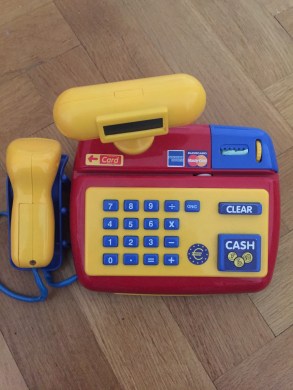
Today we were playing shops for special time. We took turns being the shopkeeper and shopper. We had some barcodes and prices on pieces of paper. When it was my turn to be the shopkeeper I started making lots of mistakes. I scanned the toy bananas instead of the barcode. Then I typed in the barcode number instead of the price. When my daughter gave me some coins I tried to swipe them through the card machine.

Each time I made a mistake my daughter would correct me. I would say sorry that it was my first day being a shopkeeper and I didn’t really know what I was doing. She laughed and laughed. She found it hilarious when I pretended to be the automated voice of the till saying ”beep, beep, beep, this is the wrong price for bananas,” over and over again.

I could see that this play was building her confidence, she got to correct me, explaining the right numbers to type in or the right thing to scan. As children who are relatively new to the world and learning how it works all the time, this kind of play is a welcome relief from all the times when they feel confused and wondering what is going on.

Giggle parenting can sometimes be a handy tool to use when we need to get our children to do something, and it can also be simply for pure fun and laughter. As we laughed together, I actually started enjoying playing shops!

Giggle parenting is about making an investment in connecting with our children. So when we need to leave the house to get out to the real shops our children are more likely to co-operate with us. As we say with Hand in Hand parenting, connection breeds co-operation.

So try some special time with your child, and let them pick what they want to do. See if you can bring some laughter into the play, with yourself in the less powerful role.

You might also like, 5 Tips For Having Fun Playing With Your Kids, And 5 Ways To Start Laughter Play With Your Kids

Why You Shouldn’t ‘Calm Down’ A Tantrumming Child

tantrumming.jpg

When my daughter was 6 weeks old, I was going out into town to a friends house for dinner. I had just fed her and put her into her pram (I wanted to carry her in a sling but I hadn’t managed to learn how to tie it yet. Then she started crying. I started feeling edgy and nervous about going out into the world with a crying baby.

Then there were voices in the hallway, and suddenly my daughter immediately stopped crying. It amazed me, that already at this age she could have an awareness of when it felt safe to cry.

Of course it wasn’t always like this. Sometimes she’d be so full of emotions that she’d cry and tantrum wherever and whenever, regardless of who was around.

It sometimes seems that it’s the job of parents to teach our children to ‘calm down,’ to self-regulate and to learn to control their emotions. But that observation of my six week old daughter made me realise that no child actually wants to have fits and tantrums in public. Just like adults they’d much rather keep their emotions for private moments.

If you’re a regular reader of my blog you’ll be familiar with the concept of staylistening, of how crying is a healing process which allows children to release stress and tension, providing there is an adult that stays close to listen to them. (If you’re new to the concept, I have some links to learn more at the end of the article)

If our toddler throws a tantrum we may have a strong urge to make it stop, to distract our child. We may be tempted to offer our child a toy to shift their attention, to turn on the TV or to ignore their tantrum so it stops as quickly as possible.

There’s lots of advice out there about how to get children to ‘calm down’ during tantrums. A lot of this advice is gentle but it actually sends the wrong message. It gives our child the message that expressing emotions is unacceptable.

It also interrupts their natural healing process so that they don’t get to release the stress and tension that has built-up. These unreleased feelings are one of the main reasons children ‘misbehave.‘ Tantrums are challenging, and can try our patience, but when we interrupt them, we are actually making parenting much harder than it needs to be.

With staylistening, we stay and listen to the upsets, without trying to stop them or distract our child from our feelings. Instead we stay present, riding out the storm together.

If we can create a safe space for our children to have their feelings at home they’ll be less likely to have their feelings spilling out in random moments like the supermarket queue or on the bus. And as they are less full of feelings, their behaviour will be easy to manage too!

You might also like this free e-book The Secret To Transforming Tantrums, and  5 Ways To Prevent Public Meltdowns

5 Tips For Creating Emotional Safety

Listening-goes-a-long-way

Emotional safety helps children feel connected to us and feel safe to tell us how they’re feeling. This helps prevent their emotions coming out in ‘off-track’ behaviour. 

Imagine the scene. Your child has just come home from Kindergarten. The Kindergarten teacher has told you that they were ‘as good as gold’ all morning. But now they’re home they’re having multiple tantrums, hitting their younger sibling, and throwing their toys around.

Or you leave the kids with your partner for an afternoon, and they’re perfectly happy and content. Then as soon as you come in the door they’re moaning, whining, and starting to cry. What on earth is going on? Does your Kindergarten teacher, or partner have superior parenting skills to you?

Absolutely not! And it’s probably quite the opposite. What’s likely the case is that you’ve created emotional safety for your children. They sense that you are there to listen to their feelings, and so they show them, sometimes directly through crying, and sometimes indirectly through their behaviour. They may keep those feelings hidden for as long as they can, and then let them out with the person who they trust the most.

Our children need a sense of connection, and emotional safety to thrive. Their limbic system, – the socio emotional part of the brain, is like a radar that constantly scans the environment to see ‘’am I safe here?’’ ‘’Who is taking care of me?’’

As long as a child’s limbic system feels well connected to others, they can think well, and their behaviour stays on track. But sometimes they may feel disconnected or experience emotional upset, that causes the feeling of disconnection.

When this happens the limbic system senses an emotional emergency, and then the pre-frontal cortex – the part of the brain responsible for rational, reasonable thinking can’t function well. Your child may start behaving in crazy ‘unworkable’ ways, in order to try and restore connection. So they whine or moan at us, and do things they know deep down are wrong like hitting, or they start crying. They usually behave in these ways towards their closest family members, the ones that are most invested in loving, and listening to them.

One of the things most parents do at some point is to try and stop their child from crying or tantrumming. They distract, reason with, or trying to ‘fix’ the situation as quickly as possible. However crying is actually a healing process, and if we can simply be there and ride out the storm of their upsets, then children can release the feelings that are behind their challenging behaviour.

When we practise creating deep emotional safety for our children, they can move away from ‘acting’ out their upsets, towards simply expressing their feelings instead.

Here’s 5 tips for creating emotional safety

  1. Let Your Children Have Their Feelings – If your toddler throws a tantrum, don’t try to distract them, or fix things instantly. Instead be there and listen. As parenting educator Dr. Deborah Macnamara says, ‘crying is not the hurt, but the process of being unhurt.’ Most of us grew up with our emotions being ignored, or stopped, so it can be hard to have patience with our children’s upsets. I like to think of them as nature’s behaviour regulation system. If we can stay close, and try to be calm, then our child can get their upset out, feel better and then behave better.
  2. Have Special Time Doing What Your Child Loves – Set a timer for 15-20 minutes and then spend time doing whatever your child wants. Shower your child with your love and undivided attention. When you do this regularly it lets your child know that there is a safe place to go to have your full attention and listening.
  3. Play and laugh together – Children often use play to work through issues in their lives. So if your child wants to play schools with you, perhaps there’s something about school they need to figure out. Children often get hurt when they feel powerless. Perhaps they got frustrated about doing what the teacher said, or another kid was aggressive towards them. Turning the tables in play and letting your child be in the more powerful role can be very healing. So let your child boss you around or be the teacher, or make ‘mistakes’ to give your child the upper hand.
  4. Set limits on behaviour and listen to the feelings – When we set limits, we can say no with love, and listen to the feelings. This allows your child to release any upsets that were causing them to behave in ‘’off-track’’ ways. This way of setting limits actually builds closer connections rather than causing frustration and friction between parent and child.
  5. Get Emotional Support For Yourself –  This kind of peaceful parenting isn’t easy. We’re often nurturing our children on a much deeper level than we experienced as a child. Do things that help you relax and feel nurtured. Spend time with friends, who you can talk, laugh and cry with. The parenting approach I teach – Hand in Hand parenting, also has a free  listening partnership scheme where you can exchange time talking and listening with other parents. This provides us with the emotional safety we need so we can then be more fully present for our children.

For more information about using Hand in Hand Parenting to help children with their feelings check out my book Tears Heal: How to listen to our children

tears-heal2016

15 Playful Ways To Get Children To Walk

walking.jpg

When our kids first learn to walk, they may be so determined it’s hard to stop them. However once the novelty wears off there may be moments when we’re on our way somewhere and they get grumpy, whiney and don’t want to walk.

Sometimes it could be that they’re just genuinely tired. At other times they may simply get bored. Walking in a straight line can be pretty boring for a child! It could also be that they are feeling disconnected,  or are experiencing upset feelings. They may start telling us about their feelings through being grumpy and whiney, and wanting to be carried.

Ariadne Brill of Positive Parenting Connection shared with me that we can become aware of when children are using the movement from the walk as a means of letting us know they need to be listened to. Sometimes we can use staylistening, to help them through these difficult moments. At other times laughter and playlistening will seem more appropriate.

If we need to get somewhere, and our child just doesn’t want to walk, or we are physically exhausted and just can’t carry them anymore, a little bit of play can help give children the burst of energy they need to keep going. Some of these tips can be used for when you just want to get home from the supermarket. Others can help everyone enjoy family hikes in the countryside. Repeat each one as long as the giggles are flowing, and you are going in roughly the right direction!

  1. Mummy limpet and baby limpet – In this game. We pretend we are the mummy or daddy limpet, and our child is the baby limpet. We tell our child in a playful tone that they must stay stuck to us the whole time and we really hope that they don’t get unstuck and run away. This is the ideal invitation for them to do just that. We can chase after them saying, ”oh no! My limpet’s running away, I need to catch her and get stuck again.” We can also play when we get unstuck from our child, and go forward a metre or two. We can then call out to our child, ”Oh no, I got unstuck! Quick catch up with me!”
  2. Runaway Buggy – Exercise keeps me sane and as we live in the countryside, I like to go on a walk most days. I have encouraged my daughter out of the house by taking a buggy where she can sit and eat snacks. Eventually she gets bored and actually wants to walk. Sometimes she needs a bit of persuasion, so we play runaway buggy, and I ask for her help to chase it.
  3. Buggy Races – I sometimes pretend to speak in the voice of the buggy, and ask my daughter to race her. Then the buggy makes the mistake of starting to race even though she’s still sitting in there. This makes her laugh. Eventually she’ll get out and want to do a real race.
  4. Make it Fun Melinda Taylor Shoutens of the website More 2 Explore says ‘ We bring loads of snacks. The children collect sticks. We bring bubbles and stop for breaks. We also search for treasures along the trail and seek out wild life. ”
  5. Go Somewhere Fun And Child Friendly – Choose somewhere with interesting things to look at along the way, for example this Adventure Dwarf trail in Muggenstutz, Switzerland was recommended to me by Melinda Taylor Shoutens. It has been designed with little hikers in mind.
  6. Try A Treasure Hunt – Ariadne Brill  says, ”For a simple scavenger hunt, for example, we have drawn pictures of things we think we might be able to find along our walk. Sometimes we even draw super silly things like a purple elephant, and then of course I get to pretend to just have seen it and spark up more curiosity and the need to keep walking.”
  7. Bring Binoculars and Magnifying Glasses My friend Karin recommends bringing along these gadgets to make exploring a bit more interesting. You might also want to try books in the I-Spy Series where you go into nature and tick off the thig
  8. Try Geocaching – Geocaching is a real life treasure hunt, with lots of tiny boxes hidden in millions of places all over the world. Walking to get from A-B may not be fun, but hunting for treasure is! For more info see the Geocaching website.
  9. Runaway ball- This one is good for the countryside, but not so good on a busy street! Have a ball in your bag, and when your child starts complaining about being bored or tired get the ball out and throw it down the path. Then you and your child can chase after it. Repeat!
  10. Silly Legs – Have your legs suddenly walk backwards, or sideways, or in zig-zags and then tell your child, ”oh dear! My legs have started going all wrong. Can you help me please?” They will enjoy being in the more powerful role as they sort your silly legs out. If you try the sideways walk you might want to tell your child that you have turned into a crab. Say, ”come on baby crab.” If they’re still going forwards you could say, ”hmm. This must be a human child, she doesn’t seem to be walking right for a crab.”
  11. Crazy Wind That Blows You Along The Road – Ask your child if they can feel the wind blowing. Tug at your child’s hand and tell them that there’s a wind blowing your down the road. You’ll get where you need to go much fast with a crazy wind blowing you.
  12. Silly Scooter – If your child has a scooter with them that they no longer want to ride you could turn it into a silly scooter. Have it jump down the road, or land in funny places, or go backwards or sideways, and ask your child to help catch the silly scooter.
  13. Pull Along Stick – If you’re in the countryside, find a stick and pretend it is a train, or bus, that will pull your child along. Have the stick go really fast to add excitement. Or have it go really slow, and start complaining to the train saying, ”Excuse me train. I need you to go a bit faster than this!” This put you in the less powerful role, so is likely to get your child giggling.
  14. Fast Bit – When you are walking along the street, and your child is complaining about being tired tell them that you think you are coming up to a fast bit. Then pull your child’s hand and start running. Build your child’s sense of anticipation, and put yourself in the less powerful role by saying, ”I hope that’s the end of the fast bits for now. Oh no! There’s another fast bit.”
  15. Jungle Walk – From Hand in Hand instructor Skye Marilyn Munroe of Nurturing Connections.We live at the top of a hill ( the things you do for ocean glimpses !)
    At the bottom of the hill is a playground. Mr 4 is super keen to walk TO the playground, and does it without a worry.The walk home is not always as pleasant. Mr 4 has been VERY interested in jungles of late…”Oh no!” I exclaim “We are stuck in the middle of the jungle, how will we ever get out of here & home?! Please help me Mr Explorer!” “FOLLOW ME!” He cried, immediately buying into it.We trekked through the arduous jungle, fighting through tangly vines, dodging coconuts thrown by the cheeky monkeys and freezing like statues anytime a dangerous jungle animal ( aka car) approached. We even had to do a tricky river crossing (zebra crossing) We ran, we stalked, we crawled our way to safety (home).It was super fun and we made it home in record time!

I hope these ideas making walking with kids more fun and playful. To read more of Ariadne brills wonderful tips check out Fun Ways To Motivate Children To Take Long Walks. You might also like, Sensory Walk: A Sense Of Touch Walk

Diary of an imperfect mum

A Mum Track Mind

The 10 Minute Fix For Power Struggles

specialtime

This morning we were due to leave the house for a picnic. My daughter had got herself dressed and now she needed to go to the toilet, and have her teeth cleaned. She came to me with a grumpy look on her face, and said, ”I don’t want to do the things you say.”

Okay I thought, and I wondered how I was going to get her out of this mood. I decided to change track completely. ”Do you want to do special time? And then we get ready afterwards?”

”Yeah!” she said. I set the timer for ten minutes. We played Duplo and her train set. We chased a runaway horse which kept leaving the farm, and driving away in car. After 10 minutes of laughter and connection, she happily went to the toilet and cleaned her teeth.

If you want to get out of a power struggle with your child one of the quickest ways is to completely forget about it for a while, do some special time and then go back to it. So factor in an extra 10 minutes, and have special time as your secret weapon, ready for whenever you need it.

In Patty Wipfler’s book Listen: Five Simple Tools To Meet Your Everyday Parenting Challenges she explains how when children get used to having regular special time, they sometimes even ask for it when they sense they need extra connection. So you can proactively prevent behavioural struggles by making special time a regular part of your family life.

For more getting ready solutions try 15 Tips For Getting Out Of The House With Kids 

And for more ways to rescue challenging situations with special time  try 10 Ways To Use Special Time To Transform Your Day