Blog

Why Using Screentime Doesn’t Make You A ‘Bad’ Parent

screentime

When I wrote my last post, The Trust Approach To Screentime, I read a comment from a mum guiltily admitting to using screentime when she needed a break from her children.

It made me reflect on just how hard it is to be a parent in this modern age. As well as being parents, many of us have responsibilities to work outside the home. We often live away from our families so we also lack support and childcare.

Not only that, unlike previous generations, being a parent these days isn’t just about keeping your children fed and clothed and then opening the front door to let them play outside. We know much more about the close connections our children need to thrive, and so many of us are working much harder than previous generations to be ‘good’ parents, to connect with our children on a deep level, and to listen to their feelings, just like we do with Hand in Hand parenting. All of this work is unpaid and often unrecognised by the larger society.

Plus we live in the digital age, where we’re constantly being bombarded with more and more technology. And not only that, parents often feel shamed and judged when they actually allow their children to use this technology!

I sometimes have these moments when I’m playing with my daughter, and I know my heart’s just not in it. I’m exhausted, and I’m faking it, as I roleplay shops or play Lego. In those moments I often notice that my daughter gets ‘bored.’ Her limbic system (emotional brain) can sense that I’m just not feeling enthusiastic about playing. If we go and watch TV instead, it’s actually a relief to both of us.

When I’m lacking the attention to connect, I try to remind myself that it’s not my fault. It’s not my fault that we live in a capitalist society that doesn’t value the most important job in the world. It’s not my fault that I sometimes get tired. I’m doing the best I can. It’s not my fault that when I was young adults didn’t play with me. It’s not my fault, that we are shamed and judged for not being perfect even though we are all parenting under imperfect circumstances.

So when I’m feeling drained we might have some screentime. And I’ll make a mental note, to find more support for myself, and get some listening time. I don’t want to rely on screentime to get through every single day, and every time I get listened to I get closer to being the parent I want to be.

You might also like:

The Listening Cure For When You Just Don’t Feel Like Playing 

5 Tips For Having Fun Playing With Your Kids 

Hand in Hand parenting’s online self-study course for Building A Listening Partnership 


The One Thing I Wish I’d Known About Baby Sleep

Sleeping_baby_with_arm_extended

photo credit D. Sharon Pruitt

When you become a parent, there’s so much information out there that it’s easy to get lost. And a lot of parenting information out there is just plain wrong, or completely unscientific. This is often the case when it comes to sleep.

Before my daughter was born I was lucky enough to read an amazing book that changed the course of my life; The Aware Baby by Aletha Solter. I read all about the healing power of tears and how babies cry for two reasons : not just to get their needs met, but also to heal from any stress and upset in their lives. It was so amazing to me that there is a way to raise children that don’t need to recover from their childhoods.

But reading a parenting book before becoming a parent, and putting that knowledge into practise as the parent of a real live baby are two completely different things! When I reread The Aware Baby later, I realised I’d forgotten half the contents.

And I’d been making a ‘mistake’ with my daughter’s sleep. One that perhaps 90% of parents make.

I had been thinking it was my job to get my daughter to fall asleep. I had been bouncing her, and pacing the room with her, or singing to her, until she closed her eyes. Because there was this time in the evening when she would start crying, and each time I fed her she wouldn’t seem to be hungry. So I would attempt to do things to stop the crying.

It was only six months later, that I began to piece together my experience as a new mother, and the book I had read. I suddenly realised that I was creating my daughter’s sleep problems, without even realising it.

Aletha Solter says that all babies naturally cry at the end of the day to release stress and tension. It could be from any overstimulation they’ve experienced during that day. It could be more extreme upsets such as stress in pregnancy or a difficult birth. This is a natural and healthy healing process.

However we don’t understand it. Nobody told us about the healing power of tears. When our babies cry we think it’s our job to get them to stop, even when they don’t have a particular need.

My daughter was naturally trying to cry at the end of the day, and I was trying to stop her by any means possible. Sometimes what I was doing was simply to stop the crying. As she got older and into more of rhythm I thought I was ‘putting her to sleep In actual fact what I was doing was stopping the crying that happened before she fell asleep. In doing so I was actually making the falling asleep process take longer. Also, when she couldn’t fully release those tears, she began waking frequently at night, a sign I later realised that she had unresolved emotional tension. In effect I was creating my daughter’s sleep problems because I wasn’t aware of when I simply needed to listen to her feelings.

I wish I’d known that we don’t have to do anything to ‘get’ our babies to fall asleep. We can simply be there and allow them to fall asleep naturally. When they are young they will cry because they need to. They need to cry, and for us to be there to listen. Being born, is an enormous life experience for babies, that takes a lot of processing. As they get older they will need to cry much less, and will fall sleep easily and sleep well.

Luckily it’s never too late to learn to listen to tears. When I began listening to my daughter’s feelings, without trying to distract her from them, or stop them then she began sleeping much better.

If you have a baby or toddler who takes a long time to fall asleep, wakes up frequently or early, then check out the links below. You can help your child to naturally regulate their emotions, and their sleep.

Further Resources 

Hand in Hand parenting’s New Parent Podcasts

Sleeping Through The Night

Hand in Hand’s online self study course Helping Young Children Sleep

5 Ways To Encourage Independent Play

independent

Independence is something we want to encourage in our children. We want them to grow and venture out into the world to make the most of their lives. And in the short term we would simply like 15 minutes (or even 5!) to finish our household tasks without interruption.

I recently read a post by someone who said that children don’t need to play with adults. Now Hand in Hand parenting is an approach that really values the connection between parent and child. It’s not just about cooking, and cleaning up after them, and reading bedtime stories at night. It’s also about getting down on the floor with them, having a glimpse into their world, and an understanding that the power of our attention can be deeply healing.

An adult can’t replace a child’s need to have friends, and playmates. But an adult can connect in a way that meets a child’s need to process, and recover from any stress and upset in their lives.

Using the Hand in Hand parenting listening tools, naturally fosters independence in our children. With a big dose of connection they can internalise us as a safe base to go off and explore the world, whether it’s across the room, or away on a play date or sleepover.

Here are 5 tips for using Hand in Hand parenting to encourage our children’s independence.

  1. Get Some Listening Time For Yourself – How do you feel about your child’s ability to play independently? Do you feel frustrated by their clingyness and constant demands to ‘play with me!’? The emotional part of our children’s brain contains mirror neurons that reflect and pick up on the moods of the people around them. If we’re getting frustrated at their clingyness or constant need for attention, they’ll sense something is wrong and might respond by becoming even more clingy! When we get listened to we can clear out our minds, of all the feelings that get in the way of thinking clearly about what to do. Then we’ll be in good emotional shape for the next steps.
  2. Give Your Child Some Attention – Larry Cohen the author of Playful Parenting
    says, I’m always amazed when adults say that children “just did that to get attention”. Naturally children who need attention will do all kinds of things to get it. Why not just give it to them? When we try to get our child to play independently by saying ‘go play,’ or telling them we’re busy this can be counterproductive. If their requests for play are constantly rebuffed they may start asking for attention in more challenging ways. They might then go and hit a sibling, or pull the cat’s tail. If we can respond by saying yes, when children ask to play their connection cup gets full so they’ll be more chance of them playing independently in the future. I found this Ted talk by Shonda Rimes incredibly moving. She talks about how for one year she said yes every time her children asked her to play. I actually don’t think we should say yes every single time (see my further tips!) but saying yes as much as we can is a good aim to have.
  3. Do Some Special Time – Make special time a regular part of your life. It could be that a fixed time each week works for you. It could be that you notice the moments when your child feels disconnected, and use special time to build a sense of connection again. Sometimes when special time is over they will continue to play contentedly as happened in my story here. Special time helps our children internalise our presence so they feel safe to explore by themselves.
  4. Listen To Big Upsets – So you just did special time and found that your child did not happily continue playing with their Lego as per step 3!  Instead they started lying on the floor and tantrumming because you told them you had to go and tidy up the kitchen. Contrary to popular belief, crying is not necessarily a sign that your parenting methods aren’t working. Sometimes it’s actually a sign that they are working. As you’ll know if you’re a regular reader of my blog, crying is a healing process. If you have played and given your child attention then they sense that you are available to listen to their bigger feelings. They use your limit as a trigger to release these feelings. Holding the limit while listening and staying close lets your child release feelings that get in the way of them feeling safe enough to play independently. Whenever upsets come up, it’s always good to stay in the moment and listen, rather than trying to distract or fix. Releasing big feelings in your presence allows children to connect deeply to you, and with that connection internalised they feel safer to play independently.
  5. Use Giggle Parenting You might find that you finish special time and your child doesn’t happily continue playing by themselves, nor do they throw a big tantrum. Instead they whine and moan, and follow you around. In this case, they may need to build their sense of connection with giggle parenting. If you’re going to tidy up, you might like to invite them to be ‘untidy’ to get the laughter flowing, as I did in this blog post here. Or you might want to put items away in the wrong places and then start exclaiming, ”oh no! That’s not right! Where does that go again?” get confused at your mistakes. Soon enough they’ll either be happily helping or you, or decide they’d rather play by themselves.

I hope these tips help your process the feelings that can get in the way of them playing independently. Do let me know how you get on in the comments below!

Further Resources 

A Little Special Time In The Morning – How Starting the day off right encourages independent play.

Giggle Parenting Inspiration for a clingy, ‘shy’ Toddler  – How a little laughter can encourage independent play.

10 Ways To Use Special Time To Transform Your Day – Adding little moments of special time throughout your day can encourage independent play.

The Special Time Cure For Bossy Parents

Helping-My-Son-3-467x700

Hand in Hand parenting calls special time the 10 Minute Tool To Change Your Child’s Behaviour. However it’s not always our child that needs to change their behaviour. In fact a lot of parenting challenges could disappear when we change our behaviour.

So lets start with special time. Do you have those days when you feel like you are issuing non-stop orders to your child? When you need them to clean their teeth, eat breakfast, get out the door, etc. etc.

I have days like this too, and suddenly I’ll remember special time, and how powerfully things turn around when we stop being our child’s boss, and let them be in charge instead.

Special time is 1-1 time we spend with our child doing whatever they want. It could be eating chocolate, snuggling up watching TV, or playing Lego. As long as it isn’t dangerous. With special time we always set a timer, so we both have a clear idea of how long it will go on for.

If you find yourself becoming bossy, and notice that the connection with your child is getting frayed then try some special time. It’s the quickest way to shift out of power struggles and back to connected-parenting. And even if you’ve only got five minutes it still makes a difference.

You might also like, 10 Ways To Use Special Time To Transform Your Day, and Ending Power Struggles With Children

Struggling to connect? Learn to de-stress and fill your own cup with listening partnerships. Check out Hand in Hand parenting’s online self-study course, Building A Listening Partnership.

How Listening Transforms Anger To Sadness

Sadness.jpg

The other day I was feeling angry. I was stressed about getting the house ready for visitors. I was stressed about getting out of the house on time to go to the supermarket. I was snapping at my daughter, and although I kept apologising afterwards those apologies were starting to sound pretty meaningless as I repeated the same mistake over and over again.

I had the sense to tell my daughter that it wasn’t her fault, that I just hadn’t had enough listening time. Then I sent a message to my listening partner, and we arranged a ten minute listening time while my daughter watched TV.

As soon as I started to talking to my listening partner I began crying. I started talking about how in August my daughter would be starting school, and how much this worried me. I talked about the different choices I had, and how one that had seemed like a great choice, turned out to be not so good after all. I grieved about how much I wanted to homeschool but couldn’t unless I moved. I cried and cried as my partner just listened.

I hadn’t realised that beneath all that anger was this grief about our school situation. I had been so busy getting on with doing stuff, and caring for my daughter’s needs, that I didn’t have the time to think, ”oh, I’m stressed out and snappy, it must be because I’m sad beneath the surface.”

After that I was in a much better mood.The school situation hadn’t been solved, but I’d let go of some of my feelings.I remembered I wasn’t alone.  I could think more clearly and connect much better with my daughter.

Hand in Hand parenting is a very special kind of parenting approach. It really begins when you seek out the support you need and parent yourself. When you understand and process your own emotions.  Only then can you truly listen to your children’s emotions.

Next time you or your child get angry, remember this, that there’s sadness beneath the surface. When we have the connection we need to release our feelings, we can heal and move on.

Need more help for your own anger? Check out 15 Tips To Stop Shouting At Your Children, and Hand in Hand parenting’s online self-study course Building A LIstening Partnership

Need more help for your angry child? Check out Hand in Hand parenting’s angry child articles

The Trust Approach To Screentime

IMG_1827

As I blogged about in my last post, my daughter is recovering from a bad fall, where she landed hard on both knees. She has as the doctor described it, ‘knee concussion.’

The day before she’d mainly lay down the whole time until we went to her doctor’s appointment. She can’t walk more than a few steps at the moment. I woke up this morning dreading the amount of screen hours she’d be clocking up, and how fried her brain would get!

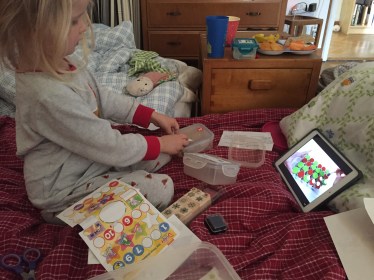
What happened wasn’t exactly like that. My daughter came across a youtube video about making your own homemade advent calendar. She then wanted to make her own with tupperware boxes for presents, with stickers and numbers on top.

We then ended up making santa and snowmen out of paper, to wrap around toys for surprises. A little unusual for this time of year perhaps! After that we had our own imaginary youtube channel where we wrapped up surprise toys for each other.

All of this was entirely self-motivated on her part. I didn’t need to go and look on Pinterest for complicated crafts (thankfully!). I just sat back and helped her when she needed sellotape or when there was something she couldn’t figure out for herself.

Recently I’ve been trying to let go of my fear about ‘screentime.’ To simply watch and wait for my daughter to notice when she’s had enough and do something else. No power struggles necessary.

It started one morning when I’d been on my computer for longer than normal. I’d been writing blog posts, jumping back and forth between facebook and twitter until I began to notice that I was losing concentration. I knew I needed to stretch my legs and do something that involved movement, such as tidying up and cooking. If I had the awareness to know when my brain had had enough screen could my daughter do the same?

There will be times when our children do use the screen to zone out, to mask emotions, and escape from reality. They’ll be times when it seems like the best idea to set a limit. Today wasn’t one of those days.

Our society tends not to trust children. We set limits on their screentime, because we struggle to trust that they might actually know when we’ve had enough. I’ve been trying to do the opposite, to let go of fear, and recognise the times when my daughter is thinking clearly, and knows when it’s a good time to turn off. Many times she’s told me, ”I’ve had enough screen.”

We can take a leap of faith and learn to trust our children. When we do so we help to nurture their own awareness. They can listen to their ‘inner-knowing’ of what they need to grow and thrive.

Would you trust your child to know when they’ve had enough screentime? I’d love to hear your thoughts in the comments below.

Further Resources

For more info on the Hand in Hand parenting approach to setting limits check out their  free e-book or the online self-study course, Setting Limits And Building Co-operation

 Raising Confident Children Through Trust, by Torsten Klaus of Dad’s Talk Community 

Why We Need To Trust Children To Play Outside, by Amie Gabry Perea

A Mum Track Mind

The Time To Listen To Tears

crying-572342_960_720

A few days ago my daughter fell down hard on her knees outside our apartment. Afterwards she walked a few steps, and then was crying so much that I picked her up and carried her home. She kept crying for a long time, and then after that she didn’t want to walk. I wanted to take her leggings off to spray some antiseptic on them and it took a long, long time and lots of staylistening for her to feel comfortable for me to even do this.

It didn’t occur to me that anything was broken. Although the crying was initially about the pain, it also seemed to be emotional, about the shock of what happened and the fear of seeing blood.

When the next day she still didn’t want to walk I put her in her buggy and took her to the doctor. When the doctor started touching her legs,  she screamed and started crying and crying. I listened to her, and tried to explain that the doctor needed to look at her legs. She kept crying and crying, holding out her arms to me.

I tried to explain to the doctor, that she ‘just need some time.’ I knew that if she had time to express her fear, she would then feel okay about being examined. The doctor immediately snapped back, ”I don’t have time, I’ve got patients to see.”

This was why I hadn’t immediately rushed out to the doctor’s the day before. Doctor’s don’t have time. They are busy, hardworking people, and the average GP (general doctor in British English) doesn’t have the time to consider feelings as part of their patient care.

However, I think this is a mistake. Crying is an important part of our physical health. Dr. Deanna Minich says, ‘crying is a form of detox in which we let go of our stored emotions and inner pain. It also literally eliminates inflammatory compounds, cytokines and chemokines. People who cry easily in response to emotion might even have fewer symptoms and better health than those who restrain their tears.’

The doctor was thinking about the physical well-being of my daughter but what he didn’t understand was that her crying was part of her body’s natural healing ability. If we interrupted her crying we were actually interrupting  the healing work she needed as part of her recovery process.

I wanted to be my daughter’s advocate, I wanted to be able to let her cry for as long as she needed without anyone distracting her or trying to fix, and without anyone forcibly removing her leggings and examining her before she was ready. However I also knew that unfortunately most people don’t have time to listen to children.

Luckily the doctor decided that since she was crying so much we were better off going to the children’s hospital. On the way my daughter was able to cry some more, while I reassured her. By the time we got there she was calm. We had a wonderful doctor who used humour and connection with my daughter. He talked to her and asked her questions rather than me and my husband. The respect he gave her helped her to feel safe. She didn’t cry at all as he pressed the different parts of her legs to check them.

There were no broken bones, and she simply needed to rest until the swelling went down.

The next day she had much more movement in her legs. At one point we had to go out, and she got very agitated about her blanket not being in the right position on her buggy. I sensed she had some more feelings under the surface, so I set a limit with her and I told her I would help to fix it. She cried, and as she cried, and kicked and moved her legs much more than she had the day before. She told me, ”I’m never going to get back to normal.”

I was glad I noticed this ‘broken cookie’ moment and realised that the upset went much deeper than the position of her blanket. I was able to reassure her that she was healing, and already doing much better. At one point she ran across the room in anger,  cried some more and then asked me to come and hug her. It was amazing to watch this natural healing process in action, and how expressing her feelings, helped her feel more confident and find the movement again in her legs.

This is why the greatest gift we can give our children is to find the time to listen to their tears. Doctor’s don’t have the time, with packed schedules and many patients to see. Teachers rarely have the time, with the needs of 20 or 30 children to consider. Everyone does their best, but we are living in a world where the majority of people just don’t understand the importance of listening to tears. I hope one day they do. What a happier and healthier world that would be.

Would you like help to prepare your child for doctor visits? Check out Hand in Hand parenting’s free podcast here

Learn more about how setting limits helps children heal with Hand in Hand parenting’s free setting limits e-book or the online self-study course, Setting Limits And Building Co-operation

Life with Baby Kicks

The Puppet Play Solution

puppet

This blog post was inspired by something Hand in Hand instructor Sophie Hunter shared with me when I was compiling Giggle Parenting Inspiration For A Back-Talking 11 Year Old.  She said that when she couldn’t ‘get through’ to her 12 year old daughter in the morning a toy tiger could do the job much better.

This started me thinking. If there’s anything we need our child to do, then asking and nagging isn’t the most effective way. When children are in non-co-operative, disconnected mode, that part of the brain that process language just isn’t functioning well.

Having a friendly puppet that does the asking can be much more effective. This kind of playful response goes straight to our child’s limbic brain, where those disconnected feelings are. As your child laughs and playfully responds, they increase their sense of connection with you. Then they begin to think more clearly and actually want to co-operate. As Patty Wipfler says, ‘connection breeds co-operation.’

So in my 15 Tips For Getting Out Of The House With Kids I suggested using a puppet for the getting ready tasks.

And you can use a puppet to help with absolutely anything you want your child to do. All those essential tasks, can be fun for you and your child. So Maybe the puppet helps your child clean their teeth at night or put their pyjamas on. Maybe the puppet brushes your child’s hair, or leads them out of the house, when you’ve run out of milk and they’re reluctant to go.

To add a giggle factor have the puppet do things wrong or get confused. Perhaps they put socks on your child’s hand, or brushes their knees instead of their hair. Puppets could also get shy, or run away from scary situations , building your child’s confidence that they can be the brave, confident one.

The possibilities are endless. So when you’re stuck with a non-cooperative child, and wondering how you’re going to get through the day, pick up a puppet, and see if they can do a better job!

If you try out this puppet play solution, feel free to leave me a comment, I’d love to hear your stories! 

For more tips on building your child’s confidence check out Hand in Hand parenting’s Confident Child Podcast Set 

For more playful parenting solutions check out Dr. Lawrence Cohen’s book’s Playful Parenting

Why You Should Let Your Children Be ‘Naughty’

misbheaviour (1)

Did you know that letting your children be ‘naughty’ is one of the most effective parenting tools we have? It may sound ridiculous, but it’s true. And no, I’m not talking about permissive parenting where you let your child run riot, hitting other children or destroying the house.

With Hand in Hand parenting we don’t use the term ‘naughty.’ We refer to off-track behaviour, which is how our children act when they feel disconnected, or when upset feelings are clouding their thinking. When children act off-track, the pre-frontal cortex; the part of their brain responsible for rational, reasonable behaviour can’t function well. Their behaviour is like a giant red flag they’re waving at us saying, ”help! I’m upset and I can’t think well. I need some connection!”

So how does letting them be naughty help in any way? Well, imagine your child has come home from pre-school and starts randomly pulling books of the bookshelf and scattering them across the floor. We may wonder what happened and if something upset them. We might ask them, ”What’s up? Did something happen?” and not get much of a response.

It’s not surprising that our 3 or 4 year old doesn’t always tell us what they’re feeling. When the emotional part of the brain – the limbic system – gets flooded with emotions, the pre frontal cortex, where language is housed can’t function well. They may not want to talk about it, and they may want to act out their emotions instead. (adults are often no different).

Perhaps your child felt disconnected at pre-school, because they’re still getting used to being separated from you. Perhaps another child took a toy from them and they felt powerless to stop them. They may not cry there and then, and instead save up those emotions for expressing at home where they feel most safe.

We can move in and set a limit, hold our child’s hand, look into their eyes and say, ”I’m sorry, I can’t let you throw the books.” Our child feels our presence and all of that upset, flows up to the surface, and they may start to cry. This is their natural healing process at work. When we listen without trying to fix or stop, we heal the hurt that caused their behaviour. As Dr. Deborah Macnamara says, ”’crying is not the hurt, but the process of being unhurt.” And when children feel better, they behave better. This is nature’s behaviour regulation at work.

So where does the ‘naughtiness’ come in? Well, sometimes your child may not be on the edge of tears. As you take their hand, and ask them not to throw the book they may wriggle your hand out of yours and giggle as they try to throw it again and again. Laughter is also part of nature’s behaviour regulation system.

In this example we don’t want our child throwing and wrecking our books. But we do want to follow where the giggles go, because doing so gives them the play and connection they need to help recover from what happened.

Perhaps if you have some baby cloth books, you could point them out and tell your child, in a playfully serious tones, ”these are my most precious important books, please don’t throw these ones.”

Your child will probably take it as an invitation to throw these books, and can have lots of fun and laughter as you playfully try to stop them. In my article here, What to do when your child just wants your attention I explain how this kind of play does encourage the behaviour in the moment, but in the long run, it improves co-operation because your child has got their feelings out of their system.

So you do want to let your children be playfully ‘naughty’ in the context of a game, that doesn’t involve hurting people or damaging objects.

For example, the other day, I was tidying up in the evening. I’d given my daughter lots of attention all day, so it seemed reasonable for me to spend a few minutes putting some washing away. She started complaining, and I sensed that she had upset feelings that were making her struggle to play independently.

So I set a limit. I got down on her level, and gently told her that I really needed to tidy up. I thought she might have been on the verge of tears, but she wasn’t. Instead she hid under the covers of her bed, and told me not to come near her.

At this point I was putting the clothes into one of the drawers. Everything was neatly folded, and I said, ”I hope nobody comes and messes up these drawers.” She immediately jumped up and started trying to pull the clothes out of the drawers, while I playfully tried to stop her. We played that for a few minutes, me trying to stuff the clothes back in the drawers and then her throwing them out. She laughed a lot and then happily went off to play a game by herself.

It wasn’t that hard to fold up the clothes and put them back, and I gained time because then she was happy to let me tidy.

This won’t encourage our child to come and pull clothes out of our drawers all the time. They needed attention, and we listened through laughter, so they’ve got that behaviour out of their system.

It takes a leap of faith to allow your child to be naughty. But try it. Try it with something that won’t push your buttons, and when you’ve got time to play. For example put some Duplo bricks in a box, and tell your child ”see my lovely bricks are all tidied away, I really hope nobody comes and messes them up.”

Or, take a pile of non-important papers, and put them on the kitchen table. Tell your child that these are your very important papers, and you don’t want anyone to mess them up.

Children  do know the difference between play ‘naughtiness’ and really ‘naughtiness,’ just like a puppy knows the difference between gently biting for fun, and really biting. When they are upset they may not always act according to their deep seated knowledge of what is ‘right,’ but when we play and connect with them it helps them return to ‘thinking mode,’ so their future behaviour will be much more on-track.

Have fun and laugh, and let your child lap up your attention. Then you may find that when you do want to get something done or need your child to co-operate they will do so because you’ve invested time in connecting.

This post explains more about why children misbehave, and what we can do, The Real Reason Our Children Misbehave

Looking for more playful ways to deal with behaviour challenges? Check out Playful Parenting by Dr. Lawrence Cohen

Two Tiny Hands

15 Tips For Getting Out Of The House With Kids

1getting-kids-out-17

Thanks to Crappy Pictures for this image.

One of the biggest shocks to me as a parent was just how getting out of the house suddenly turned into mission impossible. Speaking to other parents I know I’m not alone in this!

Our children just aren’t born for our busy, modern society. They like to take their time, and get deeply involved in play. It must come as a complete shock to them when we start hurrying them out of the door, and lecturing them about being ‘on time.’

I’d love to live in a world where my daughter could take her time,  where I could just open the back door and she could run out and play with other children all day.

Unfortunately our world is not that simple. Most of us out of necessity have to, at least some of the time, get our children out of the house. And we a have a time limit.

Luckily Hand in Hand parenting has some amazing tools to help us complete this challenge. Follow these steps to get your children out of the house. There are lots of playful tips here so if you use them all you might be in for a very long getting ready process! Incorporate them here and there whenever it seems necessary to add fun and connection into your daily routine.

1. Don’t underestimate the scale of this challenge! – It seems like the simplest thing in the world. Putting on clothes and shoes, opening the door and leaving the house – before having children. Afterwards life will never be the same again. Be easy on yourself, and forgive yourself for the times you’ve snapped and lost your patience. Children’s brain’s aren’t really wired to be rushed about from place to place. But because of our lifestyle’s it’s often a necessity. So, if it gets hard, don’t think of it as some sort of ‘failing’ in you as a parent. Caring for children and their emotional lives is one of the most challenging jobs in the world.

2. Instead, seek support. Get some listening time. When we have a parenting difficulty that recurs day after day we’ll often find that as time goes on more and more feelings build up inside of us. The first step towards change is to have somewhere to take these feelings. Having another adult who can listen as we talk, moan and express how we feel means that these feelings will come up less and less in our life. So have a laugh and a cry about how hard it is to get out of the house. Then notice how your perspective shifts after being listened to. When we clear out our mind of upset we can think more clearly and can often come up with playful and creative ways to deal with the situation.

3. Have lots of connection the day before – Connection helps our children to co-operate with us. If your child feels disconnected you can bet they will tell you about it by refusing to put on clothes, clean teeth etc. Any time we connect with our children it is an investment of time that will make things go more smoothly the next day. Do some special time the day before, and plan for regular roughhousing before bed. Bedtime is the ideal time to add in extra giggles to not only make your child sleep easier, but also give children the connection they need to co-operate the next day.

4. Have a bed party – While your child is sleeping, arrange every single fluffy toy they own on their bed. As your child slowly wakes, make up a silly song like ‘welcome to the bed party,’ and have the toys throw and catch balloons. Do silly thing that make your child laugh.  Perhaps they start trying to lift your child’s pillow up instead of a balloon, or all the toys decide to leave the party by hiding under the pillow. This is the perfect alarm clock for our little ones. You can read more about this idea here.

5. Have a puppet or fluffy toy do the getting ready tasks – After hosting the bed party, have your child choose a toy to get them ready. Have the toy say silly things like, ”now I’m going to take you to the pee-pee otorium,” and ”welcome to the restaurant now I’m going to show you the breakfast choices.” Everything goes a little more smoothly when a friendly toy is the one doing the talking instead of a nagging parent!

6. Have a getting ready song. We like Hit The Road Jack By Ray Charles. If you want to add in some playfulness, you could try pretending the song is making you put on your coat and shoes, but have the song get it all wrong, for example by making you pile ten jumpers on top of you, or put on your child’s shoes.

7. Beat The Clock. Hand in Hand instructor Marilupe De La Calle says, ”We pretend that the clock is an actual person who’s trying to beat us. I say, playfully: “Oh, no! the clock is already eating his breakfast”… and my girls rush to the table. Then I keep going…”He’s putting his shoes on!! quick, put yours on!”…”Oh, he is already in his car!!!”..My girls love to “get him.” We win if we get to our destination on time.

8. Beat The Song From Marilupe De La Calle. Another trick we use is to play a song on the music player and we try to get ready (get dressed, hair done, shoes on) before it’s over. My girls get to choose the song, and this is especially funny when they pick a silly one, like a Christmas song in March.

9. The Confusion Game  Hand in Hand instructor Skye Munroe of Nurturing Connections says,  ”I like to pretend to be confused about the process – things like “ok ok I know we need to get somewhere right now , I just can’t remember what to do … Hmm ok maybe I have to open this big silver thing ( fridge) and it will be able to help me ?”
My gems will then be giggling and saying things like “no no we have to put our shoes and coats on and go out the door” and then I may open a cupboard door or similair – just goofing around so that the kids help ME ( us) get out.”

10. Squeeze in some special time. Even five minute can make a difference as this story from Hand in Hand instructor trainee Isabela Budusan shows. Starting the day with special time can be really effective. If you start the day with a bed party, you’ll already have started the day with a dose of connection, so you might want to move onto doing all the getting ready tasks, and then have special time right before leaving the house.

11. Music Montage from Ariadne Brill of Positive Parenting Connection. One of our favourite ways to get ready without struggles is to do a music montage (just like those fun scenes in movie). We choose one or two favourite songs to get shoes, coats, bags in order and dance and get ready at the same time. When the song is over we meet by the door.

12 The checking game From Ariadne Brill. Something we did when my boys were 2 and 4 years old was an airplane pilot check list. “One shoe on? Check! Another shoe on? Check! Coats? Check! A toy to bring along? Check! Everyone ready? check! Everyone buckled? Check! the children loved this game, especially if we built in silly moments like jump three times to get to the door? Check!!” feel free to edit as you need!

13. Lets leave the house – Put on a playfully serious voice and tell your child it’s time to leave the house. Take them by the hand, and lead them to the door the bathroom, and say, ”oh whoops! That’s not the way out of the house.” Repeat with other doors for different rooms, or wardrobe doors, cupboards etc.

14. Pack a silly bag – Pack a silly bag the night before full of random objects. Start talking about how you need to take this bag for you and how you need to check the objects. Pull out a swimming costume although you’re going to the park, a winter hat and gloves in summer, or some rocks from the garden. Act all surprised and confused as your child laughs and laughs.

15. Make Time For Big Feelings – If your child has a big meltdown at any time during this process it’s counter-productive to try and distract them or stop the tears. There’s a lot of articles out there about how to stop a tantrum, but this is why I recommend going with the flow and allowing feelings. Even if we do end up being late, our child will be in much better emotional shape to enjoy their day when they’ve release those feelings.

I hope these tips help the getting ready process become a joy for you and your children. If you try them out I’d love to hear about how you get on. You can let me know in the comments section below. And if you come up with any fun and playful games of your own I’d love to hear from you too!

A good morning starts with a good night’s sleep! If you need some help in this area check out my 5 Sleep Secrets For Peaceful Nights and Hand in Hand parenting’s online self study course Helping Young Children Sleep

The Secret Diary of Agent Spitback