Blog

Reader Question – For A Toddler That Wakes Multiple Times A Night

baby-1151351_960_720.jpg

Dear Kate,

I’m struggling with my 22 month old son, who has a very  busy brain and wakes between 2 and 7 times a night. At first it was colic then he had hip issues. Now it’s dreams and hunger and general wanting to chat. From ‘E’

Dear E,

I’m sorry that you’re still dealing with so many wake-ups. One of the wonderful things about Hand in Hand parenting is that there’s a lot we can do in the daytime to help our child sleep well, and we can help improve our child’s sleep without using the cry-it-out approach.

One of the most common reasons that children wake is because they are experiencing stress and tension, and they are trying to process feelings. Children experience sleep as a separation so often when upset feelings bubble to the surface they wake up seeking connection to us.

Using all the Hand in Hand parenting tools described in this post can naturally help our children to sleep better. So it’s definitely worth reading the Hand in Hand booklets and implementing them as much as you can.

Sometimes children’s sleep issues are rooted in their early life. If they had a difficult birth, or they had a difficult start or lots of medical intervention, or separation early in life, they can need an extra big dose of connection to help them recover. Toddlers may use asking for things in the night such as food, as a pretext for deeper feelings they need to heal from.

Babies are born with an inbuilt way to release stress and tension, and naturally improve their sleep – crying. However it’s really common for us to get confused about our children’s crying. Most of us were never told about this natural healing process, so we may not recognise the times our child needs to cry to heal from upsets. We may stop them by distracting or avoiding tantrums when actually our child just needs to cry.

All we need to do to help our child sleep well, is simply let go of our need to control or manage their emotions. When we make space to listen to them, they will naturally be able to relax and sleep well through the night.

Staylistening is the tool, we can use to listen to upsets whenever they arise. If we can stay close and listen to our child, when there is nothing to fix, then they can naturally release the feelings that get in the way of their sleep.

Using special time (1-1 time spent with our children doing what they love) can help deepen your connection with your child, so that they internalise a sense of having you ‘there.’ This can mean they are less likely to wake, because it deepens their sense of safety and security. You might want to try some special time first thing in the morning, or as part of your child’s bedtime routine.

Laughter is the second way we naturally release stress and tension from our bodies. Playlistening means any kind of laughter play where our child is in the powerful role. This builds their confidence and sense of security. Lots of laughter throughout the day, can help them to release any tension that may come up at night if it’s not released in the day.

Hand in Hand parenting is based on the idea that our children are naturally good, loving and co-operative. Where does your child struggle? Where are they not co-operative? If you can find those moments and add some laughter, you are not only helping their ability to co-operate, you are also building the connection they need to sleep well. Take a look at this list of ten typical challenging moments for parents of toddlers, and try out some of the playlistening suggestions.

Allow lots of time and space for your children’s feelings in the day. So if for example your child throws a tantrum when you need to leave the house to meet a friend, see if you can send apologies to them and listen to the feelings rather than rushing out. This means the feelings are less likely to arise at night.

And if you try all this and your son is still waking. Have a read of the following sleep related articles, and see if they help too.

5 Sleep Secrets For Peaceful Nights 

Helping Young Children Sleep 

Still need some sleep help? Check out Hand in Hand parenting’s online self study course, Helping Young Children Sleep 

Would you like a Hand in Hand parenting solution to your parenting challenge? Leave me a comment or use the contact form here

Silly Stories For Separation Anxiety

ruby-reading

My mum is staying at the moment, and last night my daughter got very over-excited showing off to granny! When it was her usual bedtime she was really hyperactive and talking non-stop and finding it really hard to relax.

I started telling more silly stories like these ones, to help her relax, and wind down. I began to tell her about the next day, when I’d be going out to lunch with a friend, and granny would be looking after her. I suspected my daughter might be feeling a bit nervous (as well as excited!) about this upcoming separation.

I had granny make lots of mistakes just like we do in real life playlistening. They had planned to go on a bike ride, but then I had granny get in a boat instead, thinking that it was a bike.

Then I would have my daughter get granny’s phone, and call me up in the restaurant, and tell me everything was going wrong. I would answer the phone making chewing noises, before being able to talk. After our phone conversation I would then fly back in a plane from the rooftop of the restaurant and land on our balcony at home. Then I could sort out whatever silly situation granny had got into.

I had the granny tell my daughter they were going to a park with some balls, and then have her go to the supermarket and get eggs and throw them around. Then granny said they were going on a treasure hunt, and she ended up picking rubbish out of a bin and saying it was treasure. I had granny get the entire contents of the kitchen cupboards, fridge and freezer onto the floor of the kitchen, and say that it was Lego bricks. She would take a chocolate biscuit, and say, ”mmm this Lego tastes delicious!”

Each time something silly happened my daughter would phone me at the restaurant and I would come back to sort things out.

My daughter laughed a lot, and even told me, ”this is helping me calm down.” After a while she was yawning and fell asleep easily.

Silly stories are great to tell about any upcoming separation. We can release any feelings of nervousness or anxiety through laughter. We can also build connections with our child, and reassure them (for example my daughter was in a powerful role because she could use the phone to get in contact with me so I could sort things out).

You could make up silly stories about anything. Have your child be in the more powerful role, and have some silly adults that make mistakes just like in playlistening. Root the stories in the everyday life your child knows well, but have events take an unusual twist. Catch an aeroplane to playgroup, drive a flying car or go in a secret underground tunnel. Turn your child’s worries and difficulties in life, into a story where they get to be the powerful one. Experiment with using silly stories to build your child’s confidence and release fear and tension through laughter.

What silly stories made your child laugh? I’d love to hear in the comments below 🙂 

Would you like some silly story suggestions to help with your child’s challenges? Leave me a comment or use my contact form here

The Listening Cure For Exhaustion

sleeping-1159279_960_720.jpg

Feeling stressed out and exhausted? Could simply being listened to refuel your energy and zest for parenting? 

Even before becoming a parent I was no stranger to extreme fatigue. While studying at university I caught the flu one January which turned into chronic fatigue syndrome. I spent 6 months at home, unable to concentrate on studying or doing much.

Although I recovered I often find myself having bouts of tiredness, and needing to rest more than the average person. However I have found some ways to deal with it.

In my mid-twenties when my life was undergoing many changes, I would often find myself spending long amounts of time lying in bed at the weekend, which I blogged about in this post.

I liked to journal a lot, and one day I discovered that if I journaled about my thoughts and feelings, my energy would come back much quicker than if I simply rested. I did yoga and was really interested in the mind-body connection. Over time I found that writing with an awareness of my body, helped me access my emotions, and release them. Then my energy was restored. It was amazing!

Shortly after that I found a book called Opening Up: The Healing Power Of Expressing Emotions by psychologist James Pennebaker. He conducted a famous study where participants were asked to write for 15 minutes on 4 separate occasions on the most upsetting event of their lives. He followed the participants up six months later, and found that those who wrote about upsetting events not only felt happier, they also went to the doctor less than those who simply wrote about mundane topics. Processing our emotions, can make us happier and healthier.

When I discovered Hand in Hand parenting I was stressed out and exhausted like most parents. Then I discovered listening partnerships (exchanges where two parents talk and listen to each other). I was amazed that even just 10 minutes of being listened could restore my physical energy. That the exhaustion I felt was not an inevitable part of parenting.  It had an emotional component that I could release and feel much better.

It makes sense really. Our bodies and minds are intertwined, and there’s lots of research that stress and emotional upset can cause physical conditions.

Because tiredness has always been such a big issue for me, I’ve also worked more in-depth on this topic in my listening time. Sometimes it’s been powerful just to rest with the warm attention of my listening partner. To have a few quiet moments, when I’m not doing, but just being.

I remember Patty Wipfler saying that if there’s somewhere we want to get to in our lives, simply stating where we want to be in our listening time, is a powerful way to shed the feelings that stand in the way. So one day my listening partner gave me the direction to stand up, to stretch my arms wide, and to say, ”I’m so full of energy!” with lots of enthusiasm.

When I did this, a lot of strong feelings came up. I began saying, ”No!” and I suddenly realised that part of me didn’t want to be full of energy. I had the urge to curl up and protect myself. I kept trying the direction, as more and more strong emotions poured out. As my listening partner encouraged me, I realised how much energy I did have, tangled up in these feelings.

I had the insight that my tiredness had been a coping mechanism, a way to deal with heavy emotions, to hide away, rather than face them. As I expressed my fear of saying, ”I’m so full of energy,” it gradually became easier to say it.

Although I still love to write, I no longer journal about my emotions much. I find that being listened to by another loving human being is so much more powerful than being alone with my thoughts on the page. I really needed a listener, somebody who would make a space for those feelings. Someone whose brain was in a calm, relaxed state, who could accept and welcome all my emotions.

Nowadays when i get tired, I don’t just think ”I need to rest.” I also think ”I need listening time.” And often just being listened to for a few minutes can turn around my exhaustion.

If you’re feeling exhausted, it could of course be that you’re sleep-deprived. Sometimes listening time can help us clear our minds, and help us find the strength to figure out how everyone in the family can get a good night’s sleep. And Hand in Hand has some great tools for that! 

Your exhaustion could be because there is a physical cause, such as being low in vitamins, or iron, so getting a check-up at the doctor is always a good idea.

As well as taking care of the physical aspects. Listening time can offer a way out of exhaustion, and we can parent with more lightness and joy.

Try this :Are you feeling exhausted? Find a friend or listening partner and exchange time talking and listening to each other. Vent about how exhausted you feel. Take a few minutes to rest. And if your tiredness is an ongoing challenge try exclaiming ”I’m so full of energy!” and see what thoughts and feelings come up.

For more info about listening partnerships, you can read Hand in Hand’s listening partnership booklet, or check out their online self study course

Would you like to find a listening partner? Join the facebook group Hand in Hand parent’s support to connect with other parents. 

Giggle Parenting Inspiration For TV Addicts!

IMG_1677 (2)

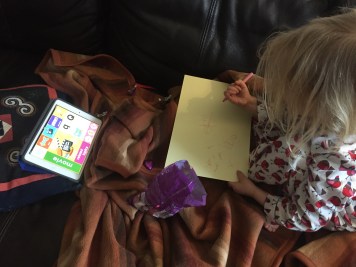
I’ve been setting a lot of limits recently. So when my daughter was watching videos on her Ipad this morning, I didn’t want to rush in and tell her to turn it off. For the last week or so I’ve felt like a big of a nagging mum, it seemed like I’d been spending a lot of time telling her to get dressed, clean teeth, leave the house etc. I needed to restore the power balance, and strengthen our connection.

So I decided not to use the Ipad as an excuse to go off and tidy up or go on my own screen. Instead I went over to the sofa, and sat with her, paying attention to what she was watching, and to her.

Then I had an idea. My feet ‘decided’ to sit either side of her, and snuggle up with her to watch the screen. They started dancing to the background music. Then my hands sat on her shoulders to watch to, then my elbows, snuggled up to the side of her.

This was a playful way to stay connected without interrupting her. My daughter joined in the game, ‘feeding’ my feet the fruit she had been eating.

Instantly we felt much more at peace. Now I was playful mum again instead of the nagging one. I was accepting her screentime instead of getting embroiled in a power struggle.

I then decided to get some soft toys to snuggle up next to her and watch. She was watching a video where they build Lego sets, so I had one of the toys do silly things like try to go on the screen and help build the set, or eat some of the toy Lego food on the screen.

So if your child is absorbed in a screen, you can use little bits of play to keep the connection strong. It’s a fine line, between sitting with your child, and being a bit playful and actually interrupting your child, and their concentration on the screen. But having your presence there, can do something to minimize the disconnecting effects of screens.

There will be times when setting limits around screentime is appropriate. With Hand in Hand parenting you can find an approach to screens that works for your individual family circumstances. Check out our free Hand in Hand parenting setting limits booklet, to learn more.


Reader Question – Separation Anxiety

fear
Dear Kate,
My little boy is 2 and every now and then decides that for 5 minutes he’s terrified of one of his loved ones. He can be excited for papa coming home then when papa walks in the door he runs away screaming in hysterical terror. Or be playing with my parents happily. Then suddenly refuse to even look at them and starts acting “scared.”
He can cry for me in the mornings then when I open the door flee bashing into walls and screaming in terror. He’s rarely out of my sight. I would never hurt him nor would anyone else. He’s been treated with nothing but love and has no reason to fear these people. He’s not shy by nature but very confident.
And 90% of the time adores his family. Then this. It’s hard not to be hurt. I don’t know why he does it or what to do. I’ve tried making a game but he gets more hysterical. Tried kissing it away but he needs space, and attacks me. It does pass after a few minutes but it’s not good for anyone while it lasts as he runs into things and could hurt himself. Any advice gratefully received, From ‘E’
Dear ‘E,’
thanks for your message. It sounds like your son is experiencing sudden bursts of separation anxiety. Often our children use normal, everyday safe situations, to ‘pin’ their fears on them, so they can have the chance to express and heal from them. It can seem strange to us when our child has a great relationship with their father/grandparents etc.
Separation anxiety is a normal part of all children’s development. It can also be related to
our child’s early life, and if they experienced any stress or difficulties.  For example stress in pregnancy, a difficult birth, or medical intervention that involved separating from the parents, even for a brief time can cause strong separation anxiety.
Hand in Hand parenting has five tools that can all be used to strengthen connection with our children and that can help reduce separation anxiety. Reading the Hand in Hand parenting booklet set, and putting all these tools into practise can really help.
As you noticed play in the moment of upset didn’t work. So I’d focus on staying with whatever emotion comes up for your son in that moment (rather than trying to shift away from that emotion). So if he’s crying or angry just try staying close, and listening to the upset. This can help your son to process the feelings behind his outbursts. This is the Hand in Hand parenting tool of staylistening.
Here is a story about when my husband came home from work, and my daughter was suddenly afraid of him. She was much younger than your son, but the listening principles are still the same.
At other times when your son is happy or fine, and in a playful mood you might want to try some of these playful games games to heal separation anxiety.
 You might also like to read this article Helping Children Conquer Their Fears.
I hope this helps. Feel free to get in touch, and let me know how it goes!
Would you like a Hand in Hand parenting solution for your family challenge? Leave me a comment or use the contact form here

Giggle Parenting N.O 10 – For Confidence

IMG_1707.JPG

Giggle parenting is great for building our children’s confidence. The more we can be the silly, less powerful one, the more they can grow and shine.

My daughter loves working through these comics,  doing the stickers, and puzzles, etc. We got to this activity, where she counted up the bugs, and then had to draw her own bug.

”You draw one,” my daughter said.

Ok I thought. Here’s an area where she doesn’t feel so confident. So I said, ”okay, I’m going to draw a square bug.” Then the pen  drew a triangle bug, so I exclaimed acting all exasperated. ”Hey! Pen what are you doing? I said a square, not a triangle!” Then I tried again drawing a rectangle bug, but drew a sausage bug instead. Then I said I would draw a circle bug and ended up with a snail. Then I drew a semi-circle bug, and added six legs. Then the pen started adding many more legs. Every time the pen did it wrong I would start, exclaiming and complaining while my daughter laughed and laughed.

It’s little moments like these that can help our children to release tension, and their confidence. With each giggle we are closer to our child believing that they CAN do it, after all.

Sleeping Through The Night Without Using Cry-it-out

Closeup of a baby girl sleeping in her mother's arms
Closeup of a baby girl sleeping in her mother’s arms

On Wednesday I co-hosted my second #SnoozeChat with @SnoozeShade and my interviewer @GreatNorthMum. This week’s topic was sleeping through the night without crying it out.

Firstly one of the things that motivates me to teach and write about Hand in Hand parenting is that there is a lot of the parenting advice out there is just wrong, and completely unscientific. Never has this been so true as with crying-it-out. Even the Doctor who invented crying it out, now admits that he made a mistake!

Crying-it-out is a really short term solution, that can worsen your child’s sleep in the long run. In the short term, a baby gives up on being responded to and may fall asleep from exhaustion, with a high level of stress hormones in their body. But as they get older they may start expressing all that stress through nightmares, or other challenging behaviour.

I think it’s really sad that so many parents are lacking good information on children and sleep. We often think our only two solutions are to ‘cry-it-out’ or ‘wait-it-out.’ That we can either wait until our child miraculously starts sleeping through the night, or that we have to resort to crying it out because sleep deprivation is making our lives really hard.

In the SnoozeChat I talked about the third way of helping older babies and toddler’s sleep through the night. It’s based on the fact that one of the most common reasons that older babies (who are not hungry) wake in the night is because of emotional reasons. Just like adults babies, and children often wake because of stress and tension.

Babies are actually born with a completely natural way to regulate their sleep, and sleep through the night when they are ready; that is crying.

When we first become parents we’re on a steep learning curve. Trying to decipher our babies cries, making sure we meet all their needs, and figuring out how to be the best expert on our baby.

One of the areas in which most new parents (including me!) get confused is with our baby’s crying. Nobody ever taught us that babies don’t just cry to get their needs met. They also cry to heal and recover from stress and upset.

So when we’ve triple checked we’ve met all our babies needs, and they’re still crying, then it’s possible they are crying to heal. For me the tell-tale signs were that this crying happened regularly, often in the evening. I kept assuming my daughter was hungry, but she just didn’t seem to want to breastfeed. I would bounce her around, trying to pace the room and use movement to quieten her, until I realised that what she actually needed was for me to sit with her and be comfortable with tears.

Babies actually need to cry a lot to recover from their arrival into the world, and to release stress and overstimulation. The psychotherapist Matthew Appleton, talks about the ‘cultural blind-spot,’ we have around birth and how it can be painful and traumatic for babies, as well as mothers.

Listening to tears is how we can help our babies recover, and when they can natural regulate their emotions they will sleep better.

We most notice times of the day when we’re avoiding our baby’s emotions by ‘shhhing’ them, feeding them when they aren’t hungry, or waving a toy in front of their face to distract them from the upset. When we stop their feelings, what we are actually doing, is stopping the natural process they have for sleeping well.

If we simply stay and listen, our babies will naturally be able to regulate their sleep, and they will sleep through the night, when they no longer need to wake to be fed (at least most of the time!.

Crying is an important signal our babies give us. We should always trust our instincts about what our baby needs at any moment, as we are the best experts on our children. We should also seek medical advice if we are concerned in any way.

As we get to know our baby, we may get an idea of when they are fine and well, and simply need to be held and cry to heal. That’s one of the most powerful gifts we can give them, our presence and acceptance of how they feel.

It was a great pleasure to share these wonderful ideas with @SnoozeShade. You can read the whole #SnoozeChat here.

And if this post resonates with you, please share it with the sleep deprived parents in our lives! Crying it out is never necessary. And the whole family will benefit from a good night’s sleep.

For more information about the healing power of tears check out my post in the Elephant Journal hereYou can also read my other sleep posts here

When Your Child Just Won’t Fall Asleep – Giggle Parenting Inspiration

IMG_1620

How Silly Stories Can Help Your Child Fall Asleep Faster 

So you’ve gone through your child’s bedtime routine, and now they’re in their bed, but you’ve suddenly realised, that they don’t seem completely tired, or they’re tense, and you’re worried it’s going to take them ages to get them to sleep.

Last night I was in this position, and when my daughter asked for another story, I said I would tell her a story. I told her about a day trip we had planned with some friends. I said we looked for a restaurant to have lunch in, and went in one and looked on the menu, and all the menu said was ”carrots, carrots, and more carrots.” She laughed at this. I then continued the story as they looked for another restaurant. They went in and looked at the menu, and it all it said was ”peas, peas, peas and more peas.” She laughed again.

I had the grown ups exclaim, ”Oh no! Not again! What is wrong with the restaurants in this town?” I drew out lots of dramatic tension by having them choose another restaurant, and say, ”okay lets try this one, I hope that doesn’t happen again.”

I repeated the game with all different restaurants, and different foods, until she told me, ”now I feel really really, tired.”

If you’re a regular reader of my blog you’ll know that laughter helps to release melatonin, the sleep hormone, so a few last minute giggles can be just what our child needs to fall asleep easily. Telling silly stories, especially ones where the grown-ups are in the less powerful role is one of many ways that laughter can be used to help your children fall asleep more quickly.

Sleep is a separation for children so they need to feel well-connected, and free of emotional upset in order to fall asleep easily. Hand in Hand parenting is all about helping children with the emotions that can make sleep hard.

Looking for more info? Check out 5 Sleep Secrets For Peaceful Nights. Hand in Hand parenting also has an online self-study sleep course

When Your Child Pushes You – Giggle Parenting Inspiration

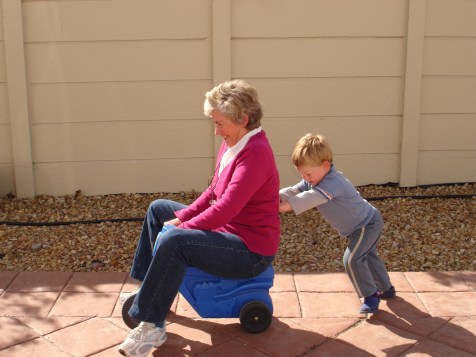
Child_pushing_grandmother_on_plastic_tricycle.jpg

Has this ever happened to you? Your child walks up to you, looks you right in the eye, and then completely out of the blue, pushes you?

Sometimes children ask for connection in the most challenging of ways. And it’s not their fault. In this article here, Patty Wipfler explains why children act aggressive when they are feeling disconnected, and how this can trigger fear and upset that causes them to lash out. Sometimes this disconnection can happen because of difficult experiences where they felt scared.

We probably don’t even need to tell our children that pushing or hitting is wrong (no child really wants to hurt others). What they do need us to is help them to process whatever stress or upset is behind their behaviour. Listening to tears can help. Laughter also plays a part.

It can take a lot of patience and understanding to save the lectures and act in a connecting way when your child lashes out. If you can manage the following game, it’s a great way to prevent aggressive behaviour from recurring. So when your child pushes you you might want to say in a playful way, ”hey!” and then actually encourage the behaviour. Tell your child that you hope they don’t push you into the living room/bathroom etc. And then stand waiting for them to push you. I’m sure they’ll take you up on your offer to play!l When you get there act all surprised about what you’re doing there. Repeat as long as they are laughing. Try pushing back (as long as it’s not to hard!) and walk backwards if that gets your child giggling.

Read here why getting giggles out in the moment actually reduces off-track behaviour.

For further reading Larry Cohen’s Playful Parenting is packed full of Giggle Parenting ideas.

Are you looking for some giggle parenting inspiration? Sign up to follow my blog for weekly ‘giggle games’ for all your family challenges. You’ll find a button to sign up in the top right hand corner of this page. Click here for the giggle parenting archives

Do you have a family challenge you’d like a laughter cure for? Just leave me a comment or connect with me via facebook and I can find a giggle answer for you!

The One Thing You Should Tell Yourself If You Shout At Your Kids

shouting

It’s not your fault. That voice didn’t come from nowhere. It’s not a reflection of your worth as a person or how good you are at this parenting thing.

That’s what we are led to believe because of the way we were parented. We were held responsible for all of our behaviour. So if we hit our sibling or stole some money from our parents wallet our parents would have most likely shouted at us/blamed us/punished us etc. We internalise this punitive, blame culture and feel terrible about ourselves.

Actually the brain science of children’s behaviour shows that when our children act in off-track ways, it’s because they got upset, scared, worried, or sad. When that happens, the part of the brain responsible for rational, reasonable behaviour isn’t functioning as well. All kids are born with a strong innate sense of right and wrong that sometimes gets forgotten in the heat of the moment. The same happens with us sometimes.

It’s not our fault, and it was never your fault. Our brains are more developed than our children’s, so we do have more self-control, but the brain science remains the same. When we get upset, stressed, worried. etc, the rational, reasoning part of our brain doesn’t function so well.

When this happens, the reason why we shout is related to our own childhood. When we can’t think through our actions well, we tend to react based on how our parents responded to us in similar situations. So if we got shouted out, hit, etc. we tend to react in similiar (albeit often less harsh ways) to our children. Sometimes, we start speaking in the exact sentences our parents used.

It’s not your fault, this is happening. It’s a reflection of the ways you were hurt as a child. But you can do something about it.

In Parenting From The Inside Out Dr. Dan Siegal explains how telling stories helps us to heal from the past, so we no longer need to ‘retell’ our history through our reactions. Making sense of the hurts and challenges we experienced means we don’t have to reinact them with our children.

The challenges you face as a parent are often a reflection of the difficulties you had when you were a child.

Creative writing and journalling is one way we can make sense of our past. With Hand in Hand parenting, we also do listening partnerships, where two parents exchange time talking and listening with each other, venting about what’s hard in parenting, and tracing these difficulties back to the past.

Forgive yourself, and nurture yourself, and it will then become easier to ‘forgive’ your child’s challenging behaviour too!

You might like to try answering this question, in a notebook, or with a listening partner. What are your current parenting challenges? How would your parents have reacted to you in a similar situation?

So print out this blog post, and keep it somewhere safe, so in those moments that you feel like you’re about to lose it you can remember, it’s not your fault. 

There is support out there waiting for you! You can join the Hand in Hand parenting group on facebook or the yahoo discussion group to find out more, or find a listening partner.

You can also sign up to my blog (on the top right hand corner of this page) so you can get regular supportive blog posts to your inbox. 

To learn more about the coping mechanisms we can use to stay calm with our kids check out my book Tears Heal: How to listen to our children

Tears Heal2016