Is Peaceful Parenting Actually Permissive Parenting?

peacefulparenting

”So peaceful parenting, is that when parents are nice to their children all the time, even when they are acting out and misbehaving? That sounds a bit permissive to me.”

I have heard variations on this statement many times, and yes, sometimes, being ‘nice’ to our children can be permissive, and not in their best interests in the long run.

Imagine the scene. You’ve had a lovely day out with your child, doing what they love, and soaking up joy and connection. At the end of the day you want to leave the park/swimming pool/playground etc, because it’s getting late. However each time you try to leave you sense your child is on the verge of a tantrum,  so you decide to stay a little longer. And then when they are still not willing to go, you try bribing with the promise of an ice cream or a new toy, because you don’t want to ruin the lovely day, you want to keep them happy.

In this scenario, we are being ‘nice’ to our child, we’re thinking of their feelings and their needs. We know they love the park and playing with their friends. And we don’t want them to feel sad.  We’re not shouting or losing our temper.

But we are also being permissive. The confusion between peaceful parenting and permissive parenting happens because of a misunderstanding of how our children’s emotions work.

Many parents often think that when a child throws a tantrum it means they’ve failed as a parent. When we have days filled with non-stop tantrums, we can feel drained and exhausted and we can often wonder what on earth we are doing wrong. It’s no surprise, that parents often choose to parent in a way that sidesteps tantrums, keeping their children happy by being ‘nice’ to them.

But here’s the thing, when a child has a tantrum, they don’t think that the day is ruined. They’re simply feeling a strong emotion, and when that emotion passes, with lots of warmth and empathy from a parent, they’ll be back to feeling good (and also behaving well) again.

Tantrums are a natural stress release, a way the body releases the stress hormone cortisol, and other hormones that effect mood. They are often not a sign that anything is wrong in the present, but often a sign that everything is right, that your child has been soaking up your love and attention, and now senses it’s a good time to release feelings from when they didn’t feel so good.

Believe it or not our child’s natural state is one of co-operation. Beneath all the ‘no’s and the refusals, and the running away. The fast track to returning our child to their natural state is by setting limits with our children when we know our requests are reasonable, and then listening to any emotional fallout, with warmth and empathy.

It’s in our child’s best interest not to be permissive, and not to be ‘nice’ because when a child is saying no to our reasonable requests, it’s actually that they have an underlying upset, and need to release some feelings. Listening to their feelings regularly means that they don’t need to tell us about their feelings through the behaviour, and we’ll see more and more that their natural co-operative nature shining through.

Peaceful parenting, doesn’t have to be permissive parenting. We can set limits in way that is loving and full of empathy, providing we are able to listen to the emotional upsets. It’s not always easy for us, and I’ll explain more about what to do about that in my next post. Sign up to follow the blog via email to make sure you don’t miss it!

Want to know more about the Hand in Hand Parenting approach to setting limits? Check out this free Setting Limits E-book or sign up for their Setting Limits Online Self-Study Course.  

https://kateorson.com/2016/06/21/is-peaceful-parenting-actually-permissive-parenting/

Reader Question – What To Do About Explosive Anger

9180389610_b9b0c2feb2_o.jpg

Dear Kate, My 6 year is experiencing extreme impulsive anger and will hit himself or hit out usually over things that seem minor recently, usually it seems quite OCD like his socks aren’t on right etc I try to be calm, I.e blame the socks not him or comment on his behaviour not him, but it’s exhausting and rarely works,any suggestions? I’m worried he’s showing OCD tendencies as things have to be just right? From N

Dear N, It’s quite common for children to have strong emotional reactions to things that are small. In fact the psychologist Aletha Solter even coined a term, ‘the broken cookie phenomenon,’ to explain why children have big emotional outbursts about something as small as a broken cookie.

What happens is that when children experience a build up of stress,and upset, they will use a small moment as a trigger for letting those feelings out. If they were feeling, relaxed and happy, the position of their socks probably wouldn’t bother them that much. But when they are dealing with upset feelings, those feelings tend to get projected onto their everyday circumstances, and nothing seems right.

In her booklet ‘Reaching For Your Angry Child,’ the founder of Hand in Hand parenting, Patty Wipfler, explains how anger usually masks deeper feelings that a child is struggling to express like fear and sadness. It could be struggles in the present like challenges in school or with friendships. It can also be that experiences from infancy, when our child was most vulnerable. A difficult birth, or medical intervention can often leave a child feeling fearful.

It’s great that you are able to remain calm when your son gets angry. One thing you could also do is to set a limit, to stop your son from hitting himself or others. You could give him eye contact, take his hands, and gently tell him, ”I’m sorry I can’t let you hit yourself.” Sometimes this kind of intervention, will give the child the connection they need to access the feelings underneath. They might cry or tantrum, and then they can release whatever upset was behind wanting the socks on right.

One of the things we often do as parents is try to stop crying, and help our child by fixing the situation and making things better as quickly as possible. But if it’s a ‘broken cookie’ scenario, this means those upset feelings tend to get stored up for a later date.

Instead if we allow our child to cry freely, without us trying to fix the situation, but simply being there to offer warmth and connection, they can naturally restore their emotional equilibrium. Tears contain stress hormones, and mood-balancing hormones, so it is nature’s way of restoring emotional wellbeing. This is the Hand in Hand parenting tool of staylistening, which literally means simply staying and listening to our child when they are upset.

When your son gets upset about these small incidences, you could try setting a limit, and listening to the feelings of upset, rather than trying to make everything right. Often what happens is that after a big cry or tantrum a child can be much more flexible and are able to deal with life’s imperfections.

Hand in Hand parenting consists of 4 other tools, (special time, playlistening, setting limits, and listening time) Each of these tools can help build the safety a child needs to release their feelings through crying. As they do so angry outbursts are reduced because a child can access their deeper feelings. One of the simplest to start with is to do regular special time with your child (1-1 time spent with them doing whatever they choose).

You can read more about the Hand in Hand parenting tools in Patty Wipfler’s Listening To Children Booklets.

I hope this helps,

Kate

Would you like a solution to your family challenge? Leave me a comment or send me a message via facebook, and you could be the subject of my next blog post.

Giggle Parenting For Grumpiness

child-1311854_960_720

If your child wakes up on the wrong side of bed, or gets whiney or grumpy it can be a sign of upset feelings under the surface that are causing them to feel disconnected.

Here’s a fun giggle parenting game to playfully add connection and shift your child’s mood. Put some music on if you’re at home, and pretend to phone someone up to order some ‘dancing energy’ for your child. Tell the person on the phone your child’s name.

Then start dancing across the room. Act all out of control, as if you can’t stop yourself from dancing. In a playfully frustrated voice tell your child, ”oh no! They’ve sent the dancing energy to me. This is not right!”

Phone back up, and complain to the person on the phone in a playfully grumpy voice. ”Hey you have sent the dancing energy to the wrong person. Please don’t send it to me, send it to (insert child’s name.” Spell out your child’s name to add emphasis.

Repeat with the person on the phone making all kinds of mistakes. They can send you crab energy, which makes you walk sideways. Or climbing energy, that gets you climbing on the sofa or table, as you frustratedly phone up the person to stop them from sending you the energy and try to send it to your child instead.

As your child laughs, their mood will shift, and the rest of the day should go much more smoothly.

For more giggle parenting solutions for all your family challenges check out the Giggle Parenting Archives. Have you got a parenting struggle that isn’t listed? Leave me a comment or send me a message via facebook, and you could be the subject of my next blog post!

Giggle Parenting For Grumpiness

child-1311854_960_720.jpg

If your child wakes up on the wrong side of bed, or gets whiney or grumpy it can be a sign of upset feelings under the surface that are causing them to feel disconnected.

Here’s a fun giggle parenting game to playfully add connection and shift your child’s mood. Put some music on if you’re at home, and pretend to phone someone up to order some ‘dancing energy’ for your child. Tell the person on the phone your child’s name.

Then start dancing across the room. Act all out of control, as if you can’t stop yourself from dancing. In a playfully frustrated voice tell your child, ”oh no! They’ve sent the dancing energy to me. This is not right!”

Phone back up, and complain to the person on the phone in a playfully grumpy voice. ”Hey you have sent the dancing energy to the wrong person. Please don’t send it to me, send it to (insert child’s name.” Spell out your child’s name to add emphasis.

Repeat with the person on the phone making all kinds of mistakes. They can send you crab energy, which makes you walk sideways. Or climbing energy, that gets you climbing on the sofa or table, as you frustratedly phone up the person to stop them from sending you the energy and try to send it to your child instead.

As your child laughs, their mood will shift, and the rest of the day should go much more smoothly.

Cracking The Parenting Code

code

Before becoming a parent I had many questions. How could I bring up my child to be happy and well-adjusted when at least 1-4 adults will have a mental health problem in their life? How could I ensure that she wouldn’t have to spend her adulthood trying to recover from her childhood?

After becoming a mum my list got much longer. Why is my child crying when I have met all her needs? Why is she not sleeping through the night? Why is every parenting book telling me something different? If I want to be a peaceful parent how on earth can I get my daughter to ‘behave’ if I’m just nice to her all the time?

Then I discovered Hand in Hand parenting. I must admit that since then my capacity for reading parenting books and articles is seriously diminished. I don’t spend all night scouring the web trying to find solutions to my problems.

Instead now I have internalised a simple universal code that I can apply to almost any situation. Here it is:

  • Children are born naturally, joyful, loving and co-operative. They don’t want to try our patience with challenging behaviour.
  • Children will be their naturally loving selves, when they feel well-connected to the adults around them.
  • When children experience stress and upset they often feel disconnected from us even when we are right there with them. Cue lots of off-track behaviour to try and reconnect with us (so-called ‘attention seeking’).
  • We can help our children release their upset feelings with laughter and play. Laughter causes a reduction in stress hormones in the body, and promotes endorphin release. When children feel better they will behave ‘better.’ (Giggle Parenting)
  • We can listen to our children’s emotional upsets. Tears have stress hormones in, so we shouldn’t try to stop them. They are nature’s way of healing and restoring emotional equilibrium. (Staylistening)
  • We can set limits on behaviour that allow room to empathise and listen to our child’s tears, or laughter.
  • Special time, (1-1 time spent with our child doing something they love is a powerful way for children to soak up a deep sense of connection to us and prevent ‘misbehaviour.’

Okay, so that’s the code you need for bringing up happy kids!

However, there is one thing that makes applying this code a little challenging and that’s our own feelings. Few of us were brought up by parents who listened to us and understand that there were emotional reasons behind our behaviour. Every day, I still struggle at times to apply this simple code.

That’s why we also need to apply this code to ourselves. To know that when we aren’t the parent we want to be, it’s because we have upset feelings clouding our thinking. To get support so we have somewhere to take our thoughts and feelings, to get them out, so we can get back to ‘behaving well’ with our child. Listening time is a tool to support us to be the parents we want to be.

You can learn more about how to apply this code by checking out the archives on my blog. Hand in Hand’s online Parenting By Connection Starter Class also helps as you can learn and connect with other parents to get the listening you need.

Have you got a parenting challenge you’d like to crack with this parenting code? Leave me a comment or contact me via facebook, and your challenge could be the subject of my next blog post! 

Cuddle Fairy
Two Tiny Hands

thumbnailsize

Brilliant blog posts on HonestMum.com

Tears Heal Launch Party in Switzerland!

Tears Heal_no foreward

Date: 15th October, 2016,
Time: 1-4pm
Location: Gymboree, Basel

Tears Heal, How To Listen To Our Children will be published this October and we’ll be celebrating! Come along to meet me and other like-minded parents in Switzerland.  Get a signed copy of the book and learn more about Hand in Hand parenting while your children play at Gymboree.

The event is free but space is limited so please RSVP by leaving a comment, or via facebook. .

If you’d like to a pre-order a book to pick up on the day, please follow the link 

Join the event on facebook to receive updates, and share with your friends.

How Crying Builds Your Child’s Confidence

crying.jpg

Did you know that crying is one of the ways your child builds their confidence? Often parenting advice centres around avoiding our children’s feelings, and stopping tantrums. With Hand in Hand parenting we teach parents how to listen to their children, so that they can grow and shine, and be their natural, confident selves. 

On Friday’s my daughter goes to a playgroup. As we live in Switzerland, the group is in Swiss German, although my daughter does have an English speaking friend there.

Recently she’s begun saying that she doesn’t want to go, even though she’s been happy there for over a year. I feel reluctant to force her to do something she doesn’t want to do. However when I ask if she wants to give up the playgroup completely she always says no, so I was pretty sure that the reluctance is more about fears and separation anxiety, than actually disliking it. I know she’s thinking a lot about starting Kindergarten in August which has increased her separation anxiety lately.

Yesterday her English speaking friend wasn’t able to go. As we walked up the hill to the playgroup she started complaining about how she didn’t want to go, and how tired she was I sensed that it wasn’t really she was tired, but that feelings were coming up about not having her friend there. So I set a limit, and told her that I was sure she could find the energy to scooter there.

She began crying, I kept walking, turning behind her and assuring her that she had the strength to catch me up. She cried for a while, and then was happy to keep scootering along.

When we got the playgroup, and it was the moment to separate from me, she started clinging to my leg. I unstuck myself, got down on her level, and told her that I was going to go. She started crying. We walked away from the other children and teachers for a while, and I listened to her. We went back and tried again. Still she was just staying stuck to me.

I knew she needed to have a big cry, to release whatever fears and anxieties were in the way of her enjoying the playgroup. But I wasn’t sure how to help her release those feelings. I also didn’t want to disturb the group.

In the end I could see no way out of the situation, so I decided that we would just go home. As we walked away my daughter started crying, and crying about how she did want to go! I listened to her until she had stopped crying. Then we went back over, and she chose one of the teacher’s to hold hands with. I left her happy and willing to give it a go.

When I came back later she was holding the hands of one of the other children. She had a big smile on her face. She told me she enjoyed it even more than when her friend was there! I think she actually liked the opportunity to connect with some of the Swiss kids as well, without her friend being there.

This is how listening can turn things around. If I’d have quickly left her, and rushed off while she was upset, she might have stopped crying, but she wouldn’t have got to release her feelings. She might not have been able to enjoy the playgroup with confidence if she was still feeling upset deep down. It was so much better to listen to those fears, and anxieties so that she could choose to go, without me forcing her, and have a good time.

When our children are faced with new situations they may feel stressed or nervous, particularly if it involves separation from us. Crying, and tantrumming are all part of our child’s natural stress-release mechanism for dealing with their feelings. When we listen without trying to stop or avoid their feelings, we can help our children to embrace life and live it to the full.

I like to give my daughter as much choice as I can in her life. I like to respect her thoughts, and ideas. When she initially told me she didn’t want to, we could of just turned around and go home. But I sensed that this wasn’t her deepest desire, or need. What she actually needed was for me to set a limit, to give her a chance to try.

When I’m due to give a workshop, , I often get incredibly nervous beforehand. All sorts of thoughts and feelings flood through my head. One time I sat on a train going to another city to give a workshop, and felt like I wanted nothing more than to get off at the next station, and head home! But actually, once I begin a workshop, and meet all the lovely parents, I end up having a great time and feel so fulfilled after sharing the amazing Hand in Hand parenting tools. I leave on a high, and immediately arrange another workshop, then as the time grows near the fears rise again! It has got easier with time though.

If I avoided giving workshops, because of my feelings, I wouldn’t get the chance t face my fears, and grow as a person. I know I need to do the same for my daughter.

It can be hard to give kids the push they need to embrace something that seems scary at first, but Hand in Hand parenting has taught me how to do it with love.

If you’d like to learn more about our approach to separation anxiety, check out my article 20 Playful Ways To Heal Separation Anxiety, or Hand in Hand parenting’s online Healing Separation Anxiety Course

How Telling Your Life Story Can Transform Your Parenting

KATE_ORSON_WEBThis post was previously published on the Juno Magazine website

When Patty Wipfler was a young mother, she met a younger acquaintance who asked her what being a parent was like. Patty burst into tears. She explained that although she had always loved children, parenting was so much more exhausting and stressful than she thought it would be. She confessed that she was starting to lose her temper, being aggressive towards her children in a similar way to how she had been treated as a child. As Patty talked and cried, the woman just listened.

Afterwards Patty went home and found that she felt completely different. She had much more energy, and renewed patience to be with her children again. When she next met the young woman she asked her what she had done. The woman explained to Patty the simple method of listening she had used, and how it can help us to release our feelings.

Patty began taking classes in listening, and exchanging listening time with another parent. She explored how simply talking about her feelings, laughing, crying, and reflecting on her own childhood helped her to get rid of the emotional obstacles that were standing in the way of her being the parent she wanted to be. She now shares everything she has learnt through her organisation Hand in Hand Parenting.

Telling your own life story is fundamental to bringing up happy, emotionally resilient children. What Patty discovered intuitively is now supported by the latest research. A study conducted by the University of California, Berkeley showed that it’s not what happens in our childhood that determines how we parent, but how coherent our story of our childhood is, and how we make sense of it.

The researchers defined a coherent story as one that went beyond simple labels like ‘happy’ or ‘terrible’ and went into more detail. Coherent stories combined events and emotions in a way that made sense, rather than being simply a description of events without the person’s emotional reactions or responses, and without clearly explaining what caused those emotions. The study concluded that telling a coherent story is the single most important factor that determines how well our children are attached to us. The researchers also found that there is a relationship between the parts of our stories that we struggle to talk about coherently and the parts of our adult life where we have difficulties.

When it comes to parenting, history often repeats itself, even when we don’t intend it to. We can have the best of intentions to be peaceful parents, but we can find ourselves losing control and reacting in ways that we are not proud of, particularly when our children do things that push our buttons. This almost always happens when we are feeling stressed and exhausted ourselves.

In Parenting from the Inside Out, Dan Siegel explains what happens in the brain when we become stressed. The limbic system – the emotion centre of the brain– gets flooded with emotion, while the prefrontal cortex – the rational, thinking part of the brain that governs impulse control – becomes deactivated. When our child does something that pushes our buttons, such as dropping food on the floor on purpose, or hitting a sibling, it can trigger unconscious memories of our own childhood and how we were treated in a similar situation. These memories activate our own strong emotions, so it’s hard to think clearly in the moment. We may respond in an automatic way rather than thinking through our response. We may simply repeat what our parents did to us when we were children.

Telling our stories helps us to diffuse some of the potency of the past. We can fully process and release our emotions about our own experiences, so that we are no longer reliving them in the present. Then when we find ourselves in a stressful situation with our children, we can bring ourselves back to emotional equilibrium and think clearly about how to respond.

Crying is an essential part of this process of storytelling. We all know the feeling of having a good cry, especially with someone we love and feel safe with. Shakespeare wrote, “To weep is to make less the depth of grief,” and now science supports what writers and thinkers have thought for years: crying makes us feel happier and healthier and is part of our natural, inbuilt recovery mechanism from stress and upsets.

Another research study showed that people in therapy were found to recover better and make more positive changes in their lives when they cried during their sessions. Through crying (and laughter too) we can release the emotional charge from our experiences, so that we can make sense of what happened and tell our stories more coherently.

When we have a supportive listener and the safety and space to tell our stories, we will be led to our tears. It might not happen instantly, as we have all to some extent developed patterns of trying to hold in our feelings. But over time we can recover our natural healing ability. We may cry about memories long buried in the past, events we didn’t even know we were upset about. Our true feelings emerge about things we may have put on a brave face about, or felt numb about. The writer Louise DeSalvo describes the recovery of feelings like these as “the things we would have felt at the time if we weren’t so afraid”.

To begin to discover the benefits of telling your story, find a friend, or begin a listening partnership through the Hand in Hand Parenting community, either online or in your local area. Ask each other this simple question: “How’s parenting going?” Spend five minutes talking, and then five minutes listening to your friend or partner. Follow some basic guidelines not to interrupt, give advice or tell your own stories while the other person is talking. Make an agreement to keep everything you say confidential and not refer to it outside the session.

You might not burst into tears like Patty did, but you will start to create the space and safety to listen to your own feelings. You can discover how your present actions relate to the past.

You can also write down your thoughts or memories. Ideally it’s best, though, to have a listening partner. That way when you feel emotional you have someone right there to laugh and cry with. Because we have a history of hiding away our emotions, of being sent to our rooms or told not to cry, it is a powerful antidote to have someone there who really accepts us unconditionally, whatever we’re going through.

Another way of using a listening partnership is to think of the areas of your life where you’re currently struggling. It could be to do with parenting, or it could be other aspects of your life that you’d like to change. Or it could be the things that trigger you about your child, that make you lose it or feel stressed and overwhelmed. Make a note of these as potential topics to talk about. You can ask yourself (or a listening partner can ask you) whether this situation reminds you of anything in the past, or of how you were treated as a child. If we trace our present issues back to the past and release the emotion we’ve been carrying, we can think more clearly about how to deal with the present.

WhKATE_ORSON_WEB2en my daughter turned two I began noticing that she was shy around new people. This is a common response for a toddler, but it made me worried. When I was a child I was badly bullied, and I went through a time where I struggled to make good friends. I would talk about this in my listening time, simply describing whatever memories came into my mind. As I talked to my listening partner, the emotion of what happened welled up in me, and I started crying. My listening partner provided safety so that I could release feelings I’d been carrying around with me ever since the bullying.

Every time I talked about what had happened, I shed a few more of those old feelings. I noticed that after a listening partnership little pieces of my confidence came back. I became less and less shy, and more comfortable with myself. I also worry less now about my daughter’s shyness. Without my own upset feelings in the way, I could think more clearly about how to help her.

Shortly after I’d done a lot of sharing in this way about being bullied, my daughter and I were at the house of a new friend I’d recently met. Her 2-year-old son was running in and out of the room. My daughter sat on my lap sucking her fingers, a sure sign she was feeling nervous. I played a game where I pretended to be scared of the boy too. Every time he ran past, I’d jump back with my daughter, saying, “Ooooh!” Soon she was laughing. This is one of the Parenting by Connection listening tools for children that help us to help them process their emotions.

Playlistening means picking up on something that makes our child laugh, while we take on the less powerful role. We repeat it over and over to get the giggles going. When I pretended to be scared, my daughter got to feel powerful, and the laughter helped her to release some of her nervous tension. After a few more minutes of playing this game, my daughter was happy to go and play trains with her new friend, and they got on really well for the rest of the afternoon.

That day I was feeling relaxed and confident. I was able to leave my own past behind and focus on what my daughter needed in the present. If I hadn’t done the work on myself, I’d have just been sitting there feeling as nervous as she was, and I wouldn’t have been able to help her. My daughter would probably have picked up on my feelings and felt even more uncomfortable. Now I had released my feelings I could help her grow in confidence too.

Our children are our greatest teachers. They will find the places where we need to figure out more about ourselves and our past. Parenting is a chance to grow and sparkle, to be our best selves. Through the challenges we deal with, the laughter and tears along the way, we become the parents our children need us to be. Having a rich understanding of our own emotional lives lays the foundation for having the empathy and patience to cope with our children’s strong emotions.

Things to Try

  1. Tell your life story. The best way to do this is with a listener. Divide the time and take turns to talk and listen. Jump from memory to memory, following your stream of consciousness.
  1. Focus on parenting:
    1. Write down three things you liked about the way you were parented.
    2. Write down three things that you would do differently.
  1. What triggers you as a parent? What behaviour in your children evokes a strong reaction in you? Let your feelings of irritation out with a supportive listener.

For more information about listening partnerships check out Hand in Hand parenting’s online self-study course Building A Listening Partnership.

The Pramshed

Giggle Parenting For No Reason

shutterstock_343677584

A lot of my giggle parenting posts have focused on using laughter to deal with specific family challenges. Although this is a great way to apply the giggles, it’s also worth bearing in mind that of course we can laugh and have fun with our children for completely ‘no reason.’

Today I went down to the cellar with my daughter to hang up some wet washing. There were some dry towels and other clothes hanging up. As I hung up the wet stuff, I told my daughter in a playfully serious voice, ”okay, I really don’t want you to pull down that towel.”

She immediately yanked down the towel, then went to pull down a pair of trousers. I chased her around putting things back up, and acting playfully exasperated. It became a race for her to pull things down, and for me to put them back up. We had lots of fun and laughter. (by the way, the cellar floor is immaculate so I wasn’t worried about the clean washing getting dirty! And there were only a few things she was able to reach, most were too high up)

Now you might be thinking, why on earth would I encourage my child to pull down clean washing and dump it on the floor? What sort of parenting lesson does that send?

Well time and time again I’ve seen that if we let our children be ‘naughty’ in a controlled way, it massively reduces the chance that they will misbehave in real ways. We had both been ill this week and had been missing out on playfulness, so I spotted my chance to leap in and have a few giggles. I know that every time I invest time in connection, I’m increasing the chance my daughter will be co-operative when I really need her to be.

So if you have a few moments to spare, and get some inspiration for what might make your child laugh (while they are in the more powerful role) then try out some giggle parenting.

You might also like

Why You Should Let Your Children Be ‘Naughty’

What To Do When Your Child ‘Just’ Wants Your Attention

Giggle Parenting – The Best Discipline Tool Out There 

5 Tips For Creating Emotional Safety

Listening-goes-a-long-way

Emotional safety helps children feel connected to us and feel safe to tell us how they’re feeling. This helps prevent their emotions coming out in ‘off-track’ behaviour. 

Imagine the scene. Your child has just come home from Kindergarten. The Kindergarten teacher has told you that they were ‘as good as gold’ all morning. But now they’re home they’re having multiple tantrums, hitting their younger sibling, and throwing their toys around.

Or you leave the kids with your partner for an afternoon, and they’re perfectly happy and content. Then as soon as you come in the door they’re moaning, whining, and starting to cry. What on earth is going on? Does your Kindergarten teacher, or partner have superior parenting skills to you?

Absolutely not! And it’s probably quite the opposite. What’s likely the case is that you’ve created emotional safety for your children. They sense that you are there to listen to their feelings, and so they show them, sometimes directly through crying, and sometimes indirectly through their behaviour. They may keep those feelings hidden for as long as they can, and then let them out with the person who they trust the most.

Our children need a sense of connection, and emotional safety to thrive. Their limbic system, – the socio emotional part of the brain, is like a radar that constantly scans the environment to see ‘’am I safe here?’’ ‘’Who is taking care of me?’’

As long as a child’s limbic system feels well connected to others, they can think well, and their behaviour stays on track. But sometimes they may feel disconnected or experience emotional upset, that causes the feeling of disconnection.

When this happens the limbic system senses an emotional emergency, and then the pre-frontal cortex – the part of the brain responsible for rational, reasonable thinking can’t function well. Your child may start behaving in crazy ‘unworkable’ ways, in order to try and restore connection. So they whine or moan at us, and do things they know deep down are wrong like hitting, or they start crying. They usually behave in these ways towards their closest family members, the ones that are most invested in loving, and listening to them.

One of the things most parents do at some point is to try and stop their child from crying or tantrumming. They distract, reason with, or trying to ‘fix’ the situation as quickly as possible. However crying is actually a healing process, and if we can simply be there and ride out the storm of their upsets, then children can release the feelings that are behind their challenging behaviour.

When we practise creating deep emotional safety for our children, they can move away from ‘acting’ out their upsets, towards simply expressing their feelings instead.

Here’s 5 tips for creating emotional safety

  1. Let Your Children Have Their Feelings – If your toddler throws a tantrum, don’t try to distract them, or fix things instantly. Instead be there and listen. As parenting educator Dr. Deborah Macnamara says, ‘crying is not the hurt, but the process of being unhurt.’ Most of us grew up with our emotions being ignored, or stopped, so it can be hard to have patience with our children’s upsets. I like to think of them as nature’s behaviour regulation system. If we can stay close, and try to be calm, then our child can get their upset out, feel better and then behave better.
  2. Have Special Time Doing What Your Child Loves – Set a timer for 15-20 minutes and then spend time doing whatever your child wants. Shower your child with your love and undivided attention. When you do this regularly it lets your child know that there is a safe place to go to have your full attention and listening.
  3. Play and laugh together – Children often use play to work through issues in their lives. So if your child wants to play schools with you, perhaps there’s something about school they need to figure out. Children often get hurt when they feel powerless. Perhaps they got frustrated about doing what the teacher said, or another kid was aggressive towards them. Turning the tables in play and letting your child be in the more powerful role can be very healing. So let your child boss you around or be the teacher, or make ‘mistakes’ to give your child the upper hand.
  4. Set limits on behaviour and listen to the feelings – When we set limits, we can say no with love, and listen to the feelings. This allows your child to release any upsets that were causing them to behave in ‘’off-track’’ ways. This way of setting limits actually builds closer connections rather than causing frustration and friction between parent and child.
  5. Get Emotional Support For Yourself –  This kind of peaceful parenting isn’t easy. We’re often nurturing our children on a much deeper level than we experienced as a child. Do things that help you relax and feel nurtured. Spend time with friends, who you can talk, laugh and cry with. The parenting approach I teach – Hand in Hand parenting, also has a free  listening partnership scheme where you can exchange time talking and listening with other parents. This provides us with the emotional safety we need so we can then be more fully present for our children.

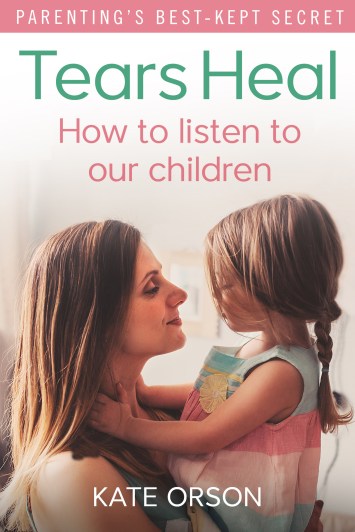
For more information about using Hand in Hand Parenting to help children with their feelings check out my book Tears Heal: How to listen to our children

tears-heal2016